

Welcome to The Tafseer Project, where understanding the Quran means so much more than reciting memorised verses. Let’s be honest—lots of Muslims across the UK can recite beautifully, but sometimes wonder what those words truly mean or how they relate to our lives.
A Tafseer Quran course changes all that. It helps students genuinely understand, reflect on, and use the Quran’s teachings every single day.

The Tafseer Project at UK Quran Academy gives people a structured, community-based way to really get what the Quran is saying. Families, adults, and teachers can all join in, learning together with experienced teachers who break down word meanings, historical context, and life lessons that actually make sense for today’s world.
Students don’t have to struggle through tricky interpretations alone. This programme takes learners step by step, from basic Arabic vocabulary to the bigger, thematic connections between verses.
People discover how the Quran talks about things like anxiety, family dynamics, and personal growth. It’s about real connection with Allah’s message—through proper understanding, not just surface-level translation.
What Is a Tafseer Quran Course?
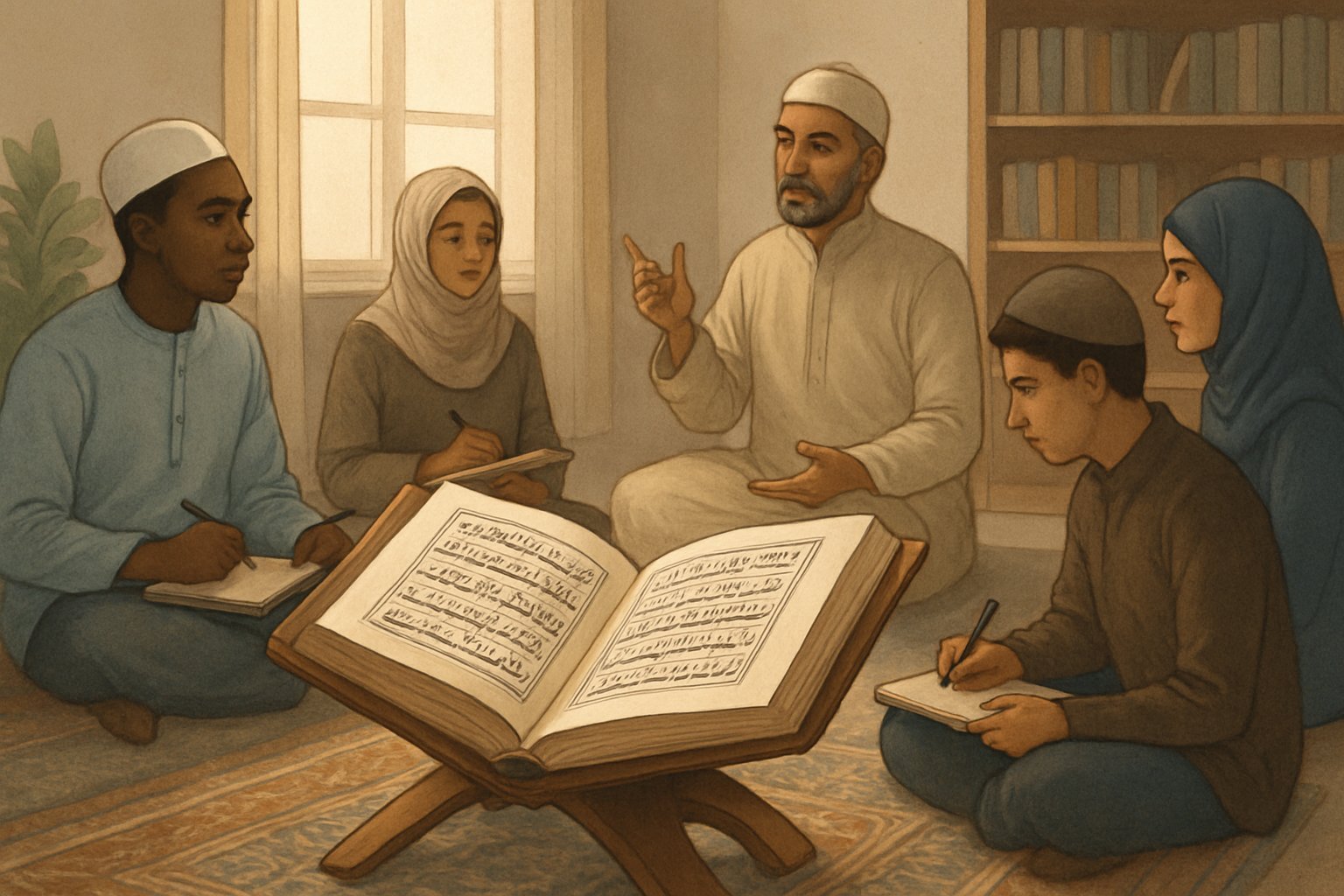
A Tafseer Quran course is a guided study of the meanings, context, and practical lessons in the Quran. Students get into word-by-word translations, the stories behind revelations, and how to bring divine wisdom into everyday life.
Definition of Tafseer
Tafseer means explaining and interpreting Quranic verses. The word comes from “fasara” in Arabic, which is about making things clear.
A Quran Tafseer course isn’t just about translating. It’s about digging into deeper meanings, the subtlety of the language, and the spiritual power in each verse.
Classical scholars like Ibn Kathir and At-Tabari built detailed Tafseer methods. They mixed close reading of the text with authentic narrations from the Prophet Muhammad (peace be upon him) and his companions.
Modern Tafseer courses adapt these classic methods for today’s learners. Students see how Quranic guidance fits with modern problems and everyday choices.
There’s more than one layer to this study:
- Literal meanings of Arabic words
- Grammar and syntax
- Thematic links between verses
- Real-world applications for believers
Difference Between Recitation and Tafseer
Recitation is about pronunciation and the beauty of reading Arabic text. Plenty of us memorise verses but might not know what they really mean.
Tafseer turns reading into real understanding. Sure, reciting brings spiritual reward, but actually getting the message? That’s what changes lives.
Someone might recite Surah Al-Fatiha perfectly but miss its deep lessons about seeking guidance. Tafseer uncovers those gems.
Online Quran Tafseer courses bridge this gap. They help students connect the sound of the Quran with its message.
The Quran itself says: “Do they not then reflect on the Quran?” (4:82). It’s a clear nudge to go beyond just reading aloud.
Learning Tafseer can transform how you feel and act. Many students say they find a deeper connection and more clarity in life after understanding verses they’d only recited before.
How Tafseer Explains Word Meanings
Arabic words can mean different things depending on context. Tafseer courses teach you how to figure out which meaning fits each verse.
Take “Rahman” in Bismillah. People translate it as “merciful,” but Tafseer shows it’s about a mercy that covers everything and everyone.
Tafseer course teachers use a few clever tricks to explain words:
- Looking at word roots
- Comparing similar words elsewhere in the Quran
- Checking how words were used in old Arabic poetry
- Reading the surrounding verses for clues
Some Arabic words just don’t have an exact English version. Like “Taqwa”—it’s about God-consciousness, righteousness, and being on guard, all at once.
Modern Tafseer Quran courses often get students to try out exercises, spotting key terms and exploring their meanings together.
This approach helps you avoid common mix-ups that come from translating word for word. It’s about catching the real intent behind Allah’s message.
Understanding Asbab al-Nuzul (Reasons for Revelation)
Asbab al-Nuzul means the reasons or situations that led to certain verses being revealed. Knowing this background makes everything click.
Lots of verses were revealed during specific events in the Prophet Muhammad’s life. Understanding those moments helps you see what the verse is really getting at.
For example, verses about patience were often revealed when Muslims were facing tough times in Mecca. Knowing that puts the advice in a whole new light.
Tafseer courses cover these backgrounds by looking at:
- Authentic hadiths
- Stories about the companions
- Timelines of big events
- Culture and geography of the time
Students learn to spot the difference between verses aimed at a specific situation and those meant for everyone. That way, you don’t end up misapplying a verse.
Sometimes revelations were answers to questions or responses to community issues. Knowing the backstory helps you see how to use Quranic guidance in your own life.
Why Studying Tafseer Is Important

Studying Tafseer totally changes how Muslims connect with the Quran. It’s not just about reciting; it’s about really getting what Allah is saying and how it fits with your life.
Clarifying Quranic Verses and Preventing Misunderstandings
Plenty of people read the Quran without knowing the full story behind each verse. Tafseer gives you the background—when, where, and why certain verses came down.
If you don’t know the context, it’s easy to misread verses that were about specific situations. For example, verses revealed during conflict need that historical info to make sense today.
Why context matters:
- Stops verses getting twisted out of context
- Explains reasons for revelation (Asbab Al-Nuzul)
- Clarifies tricky grammar and word choices
- Helps spot what’s universal guidance versus situational advice
Arabic grammar can totally flip a verse’s meaning. One word might mean several things, so scholars help pick the right one for the situation.
This guidance keeps people from guessing or relying on personal opinions. The Prophet Muhammad (peace be upon him) warned against interpreting the Quran without proper knowledge.
Applying Quranic Guidance to Modern Life
Tafseer bridges the gap between ancient wisdom and today’s world. Students see how timeless principles solve problems at work, home, and in society.
The stories of prophets and past nations aren’t just history—they’re blueprints for handling challenges we all face.
Modern lessons include:
- Honesty and ethics in business
- Parenting and family advice
- Social justice and community work
- Building good character and self-improvement
Teachers often use real-life examples. Verses about patience and trusting Allah, for instance, offer comfort when times are tough—like during financial stress or illness.
Understanding the Quran through Tafseer gives you a framework for life. It’s not just theory; it’s practical, and it really does help families live out Islamic values day by day.
Strengthening Family and Personal Connection
Studying Tafseer as a family brings everyone closer. Parents get the tools to explain Islam confidently to their kids.
Kids, in turn, feel more connected to their faith when they actually understand the stories and lessons. It makes Islam feel personal, not just something they’re told to do.
Family perks:
- Learning together strengthens bonds
- Parents can answer tricky questions
- Deeper, more meaningful conversations about faith
- Passing on a strong Islamic identity
When you know what you’re reading, prayer and reflection become much more meaningful. Tafseer turns routine worship into something richer and more heartfelt.
Learning in a group also means support from others on the same journey. Those connections can keep you motivated when things get tough.
And when life throws curveballs, you’ll know exactly where to look in the Quran for comfort or direction.
Building a Deeper Relationship With Allah
Tafseer opens your eyes to Allah’s attributes and wisdom throughout the Quran. It’s knowledge that leads to real love and awe, not just ritual.
You start to see how Allah’s guidance fits human nature and society perfectly. It’s hard not to be impressed by the Quran’s depth and beauty when you study it this way.
Spiritual growth includes:
- Recognising Allah’s mercy and justice in every verse
- Understanding the wisdom behind Islamic rules
- Appreciating the Quran’s style and message
- Personal change through living the teachings
The Quran uses all sorts of styles—commands, stories, parables—to get its message across. Tafseer helps you spot these and understand why they matter.
With this knowledge, worship becomes more than habit. You build a personal connection with Allah based on understanding, not just tradition.
Even prayers feel different when you know what you’re saying. Every word starts to matter.
How Tafseer Is Taught at UK Quran Academy

UK Quran Academy uses a mix of structured progression, expert teachers, and collaborative learning. The goal? Making Quranic understanding accessible, engaging, and rooted in real scholarship.
Step-by-Step Teaching Methods
It all starts with the basics—key Arabic words and what they mean. Students learn word by word, picking up essential terms that pop up throughout the Quran.
Storytelling is a big part of the process. Teachers share stories from the lives of the Prophets to bring Quranic lessons to life and make abstract ideas feel real.
There’s a focus on real-life application. For example, Surah Ad-Duha is used to show how the Quran can comfort you in anxious times.
Interactive Q&A sessions are encouraged, so students can ask questions and clear up confusion. No one’s left behind, and everyone gets to join in.
The Academy also highlights the reasons for revelation (Asbab Al-Nuzul) for each verse. This helps students really get why a verse was revealed and what it’s meant to teach.
Role of Qualified Instructors
At UK Quran Academy, instructors aren’t just teachers—they’re certified by Al-Azhar University and other respected Islamic institutions. Their expertise covers classical Tafseer, including the renowned works of Ibn Kathir and As-Sa’di.
These teachers walk students through authentic interpretations, steering clear of the confusion that can come from unchecked personal opinions. Every explanation sticks closely to established Islamic scholarship and the traditional understanding of the Quran.
Personalised attention is a big deal here. Teachers adjust their approach to match each student’s learning pace and background.
Expert guidance makes it easier for students to tell the difference between trustworthy Tafseer and questionable sources online. There’s a strong emphasis on learning from qualified scholars—because, honestly, who wants to get lost in a sea of unverified content?
Teachers also act as mentors, nudging students to reflect on the Quran’s teachings and encouraging them to put those lessons into action in their everyday lives.
Collaborative Learning and Group Discussions
Students don’t just sit and listen—they get involved in group discussions, sharing insights and questions about the verses they’re studying. This back-and-forth brings different perspectives, making the learning experience a lot richer.
The academy sets up peer-to-peer learning sessions, so experienced students can help those who are just starting out. It’s a supportive community, and that really keeps everyone engaged with their Quranic studies.
Group activities often include looking for themes that link different Surahs, or figuring out how various verses echo and expand on each other. Students work together, spotting patterns and messages that might otherwise go unnoticed.
Interactive discussions are encouraged—students ask questions, dig into tricky topics, and explore the text from different angles. Teachers step in to keep things on track, but they let students lead the way as much as possible.
All this collaboration builds confidence. It also forges lasting connections among learners who are on similar journeys.
Levels of the Tafseer Quran Course
| Level | Focus Area | Duration | Prerequisites |
|---|---|---|---|
| Level 1 | Basic Arabic vocabulary and word meanings | 6-8 weeks | Basic Quran reading ability |
| Level 2 | Verse explanations and historical context | 12-16 weeks | Completion of Level 1 |
| Level 3 | Major themes and practical applications | 16-20 weeks | Completion of Level 2 |
Level 1 is all about getting comfortable with key Arabic words and their meanings in the Quranic context. Students focus on vocabulary that pops up again and again in the text.
Level 2 takes things deeper. Here, students look at verse explanations, historical background, and the circumstances of revelation—because context really does matter.
Level 3 shifts the focus to big-picture themes and how to apply Quranic teachings in everyday life. Students learn to connect what they read with real-world challenges and decisions.
Each level builds on what came before, introducing new ideas and encouraging deeper analysis. The structure makes it easier to develop a thorough understanding of Tafseer methods and their practical use.
Key Components of the Curriculum
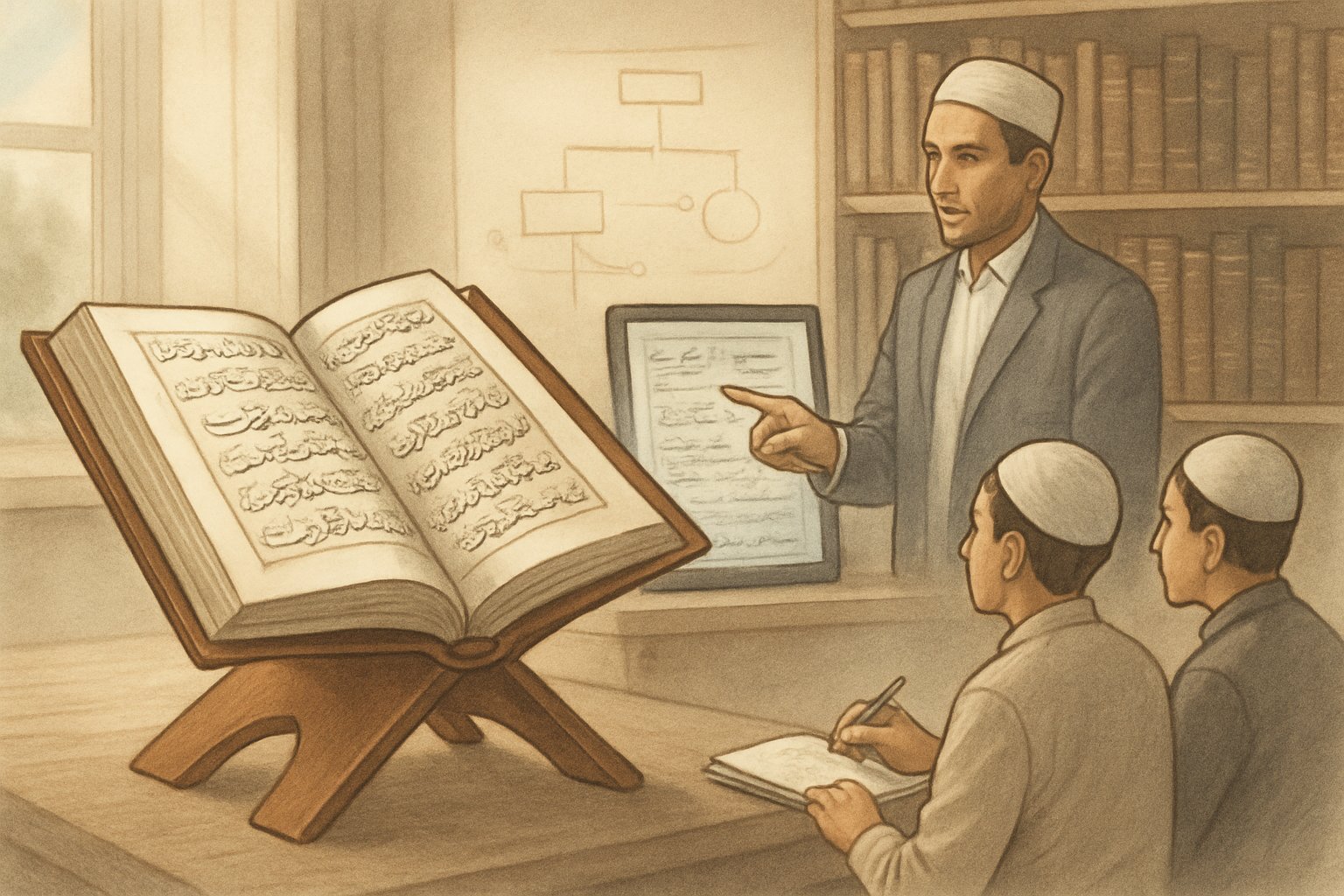
A strong Tafseer curriculum stands on three main pillars. These help students unlock the Quran’s deeper meanings, from basic Arabic skills to advanced interpretation. It’s not just about reading—it’s about understanding, analysing, and connecting the dots.
Arabic Grammar and Quranic Arabic
Everything starts with the language itself. Students learn the nuts and bolts of Arabic grammar—verb forms, noun patterns, sentence structure—because these are everywhere in the Quran.
Quranic Arabic isn’t quite like modern Arabic. It’s more classical, with unique vocabulary and style. The curriculum highlights key roots and word families, so students can spot connections across different verses.
Grammar lessons aren’t just theory. Students work with real Quranic verses, seeing firsthand how grammar shapes meaning. This practical approach makes those subtle differences in translation much clearer.
There’s also a focus on building vocabulary and reading comprehension. Students get to appreciate the metaphors, rhetorical devices, and beauty that make Quranic Arabic so powerful.
Major Themes and Lessons in the Quran
The curriculum dives into the Quran’s central messages by connecting verses across chapters. Students explore themes like monotheism, prophethood, accountability, social justice, and personal development.
Each theme is unpacked using multiple Quranic passages. The idea is to see how themes evolve and how different verses support one another, offering a fuller picture.
Practical application matters here. Students discuss how Quranic lessons relate to today’s issues—family, finances, community, and personal growth.
Teachers encourage students to find life lessons and morals they can use right away. The aim is to keep things rooted in classical scholarship but relevant to modern life.
Exploring Quranic Interpretation Methods
Students get introduced to tried-and-tested methods scholars have used for centuries. The curriculum covers Tafseer Bil Ma’thur (using Quran and Hadith) and Tafseer Bil Ra’y (using reasoned analysis).
Each method comes with practical examples. Students learn how different approaches can lead to complementary insights, and they practise applying these methods to specific verses—with guidance, of course.
Historical context is a big part of this. Understanding Asbab Al-Nuzul (reasons for revelation) helps prevent misinterpretation and brings out intended meanings.
Comparing how famous scholars approached tough passages gives students confidence in recognising solid interpretations. It’s a good way to avoid getting tripped up by unreliable sources.
Who Can Benefit from a Tafseer Quran Course?

Tafseer courses at UK Quran Academy are open to everyone. Whether you’re just starting out or looking to deepen your knowledge, there’s something here for you. Beginners, families, and community leaders all find value in these programmes.
Beginners and Adult Learners
New Muslims often find these courses especially helpful. They start with basic vocabulary and gradually move towards understanding verse meanings and context.
Adult learners who can recite the Quran but want more comprehension benefit from a structured Tafseer programme. Many have finished Noorani Qaida or similar courses and are ready for the next step.
Working professionals appreciate the flexibility of online Tafseer classes. They can fit lessons around work and family, learning at their own pace without feeling swamped.
University students sometimes join to complement their studies or just out of curiosity. The mix of academic rigour and spiritual growth is a bonus.
Parents and Families
Homeschooling families use Tafseer courses to build a solid Islamic education for their kids. Parents often learn alongside their children, which can be a bonding experience.
Mothers and fathers join to answer their children’s questions accurately. They want to provide clear, authentic explanations—not just personal guesses.
Couples sometimes enrol together, looking to strengthen their spiritual connection and spark deeper conversations about Islamic values at home.
Grandparents get involved too, hoping to connect with the younger generation and share wisdom in a meaningful way. The sense of community is a real draw.
Teachers, Imams, and Community Leaders
Islamic school teachers use these courses to improve their curriculum and teaching style. They pick up new ways to explain complex ideas to students of all ages.
Imams and religious leaders join to refresh their knowledge and explore new teaching methods. Even those with years of experience find value in fresh perspectives and group discussion.
Community volunteers—those leading study circles or youth groups—need solid Quranic Tafseer training to guide others responsibly. It’s about knowing what’s authentic and what’s not.
Mosque committee members and Islamic centre coordinators often enrol to better serve their communities. They can then organise educational programmes and point people towards reliable resources.
Getting Started: Resources and Materials Needed

Starting your Tafseer journey means having the right resources on hand. You’ll need reliable translations, a good system for taking notes, and a bit of spiritual readiness to make the most of your studies.
Recommended Translations and Tafseer Books
It’s best to begin with trusted English translations of the Holy Quran. The Saheeh International translation is clear and modern, while the Muhsin Khan edition gives detailed explanations right alongside the verses.
Essential Tafseer Books for Beginners:
- Tafseer Ibn Kathir – A classic, packed with historical context
- Tafseer As-Sa’di – Concise and straightforward; great for newcomers
- Tafseer Al-Jalalayn – Simple, direct interpretations
Many online Tafseer courses include these trusted sources in their lessons. It’s helpful to have physical copies as well as digital versions for a more rounded study experience.
These classical Tafseer works form the backbone of structured courses. They go beyond surface meanings, offering linguistic analysis, history, and spiritual insight that you just can’t get from self-study alone.
Taking Notes and Reflecting
Active note-taking really changes the game. A dedicated notebook for Tafseer reflections helps you move from passive reading to real engagement.
Note-taking Structure:
- Verse number and Arabic text
- Word-by-word meanings
- Historical context (Asbab Al-Nuzul)
- Personal reflections and practical applications
Writing things down helps lessons stick and makes it easier to apply Quranic guidance in daily life. Many people find old-school handwritten notes build a stronger connection than typing everything out.
Regular reflection sessions let you link verses to what’s happening in your life right now. That’s where understanding moves beyond the academic and starts to shape your spiritual growth.
Preparing Your Heart for Learning
Spiritual preparation is really the foundation of meaningful Tafseer study. It’s important to approach the Holy Quran with humility, searching for guidance instead of just academic knowledge.
Pre-study Preparation:
- Set your intention (niyyah) for learning.
- Perform ablution (wudu) if you can.
- Pick a quiet, clean place to study.
- Start by seeking refuge and saying Bismillah.
Mental readiness means putting aside your assumptions and being open to fresh insights. The Quran can reveal new layers of meaning as you grow in knowledge and faith, which is honestly quite remarkable.
Try to set regular study times that let you reflect, not just rush through. In my experience, engaging deeply with just a few verses is usually more rewarding than racing through big sections.
Leave A Comment