

Starting to learn the Quran can feel pretty overwhelming, especially for beginners. Whether it’s a child’s first steps or an adult wanting to reconnect, the process is rarely straightforward.
UK Quran Academy’s “Quran Reading for Beginners” course lays out a step-by-step path, taking you from the basics—like Arabic letters—to reading the Quran with confidence and proper pronunciation.
This program welcomes learners of all ages across the UK. It’s built to nurture spiritual growth in a way that feels achievable and, honestly, pretty rewarding.

Quran reading takes patience and the right guidance. The course breaks things down into five phases and 45 lessons, so students move from learning the alphabet to understanding Tajweed rules in a way that feels natural.
Each phase builds on the last, so you’re not left feeling lost. Learners gain confidence as they discover the beauty and meaning behind Quranic verses.
What stands out here is the focus on making Quran for beginners both accessible and enjoyable. It’s not just about reading; students start to understand what they’re reciting—from short surahs to daily duas that connect them to their faith.
At the end, there’s certification. That sense of accomplishment can be a real motivator, giving learners the tools to keep growing spiritually on their own terms.
Overview of the Quran Reading Course

This course is a solid starting point for anyone wanting to begin reading the Quran. It’s open to both kids and adults, with clear phases that build skills step by step.
Who Is This Course For?
Complete beginners are welcome—no prior knowledge of Arabic or Quran reading is needed. Children as young as four can join, and there’s no upper age limit.
Parents looking for online Quran classes for their kids will find teaching methods that suit young learners. Adults who want to start or improve their recitation will appreciate the structured approach too.
No previous experience is required. You don’t need to know Arabic letters or sounds before starting. Everything is built from the ground up.
Kids and adults learn together, but the pace is flexible. Teaching adapts to each student’s needs, which is honestly refreshing in a world of rigid curriculums.
Course Format and Delivery
Students get one-on-one lessons with teachers who specialize in helping beginners. Each class is 30 minutes, and you can pick 2, 3, or 5 days per week—whatever fits your schedule.
Learning Quran online means families can find times that actually work. That flexibility is a lifesaver for anyone with a busy life.
Each lesson includes:
- Live interaction with experienced teachers
- Personalized feedback and correction
- Practice exercises tailored to the student’s level
- Progress tracking to monitor improvement
Free trial classes are available, so you can see if the teaching style suits you before making a commitment. Teachers give each student individual attention, making sure concepts actually stick.
Progression Through Five Phases
The course is split into 45 structured lessons across five phases. Each phase builds on what came before, so you’re never thrown in at the deep end.
Phase 1 is all about the Arabic alphabet. There are 10 lessons focused on recognizing letters and their basic sounds. Students practice forming simple words and telling similar letters apart.
Phase 2 introduces core Tajweed rules over 10 lessons. You’ll learn about Sukoon, Tanween, Madd, and other pronunciation rules that help make recitation accurate.
Phase 3 puts those skills to use with short Surahs—like Al-Fatiha and Al-Ikhlas. Students start reading full verses, applying Tajweed in real context.
Phase 4 covers practical daily duas and common Quranic verses, such as Ayatul Kursi. This is where students gain confidence reading passages they’ll actually use.
Phase 5 is review and assessment. There’s a live recitation test, and students receive certification to mark their progress.
Phase 1: Learning the Arabic Alphabet
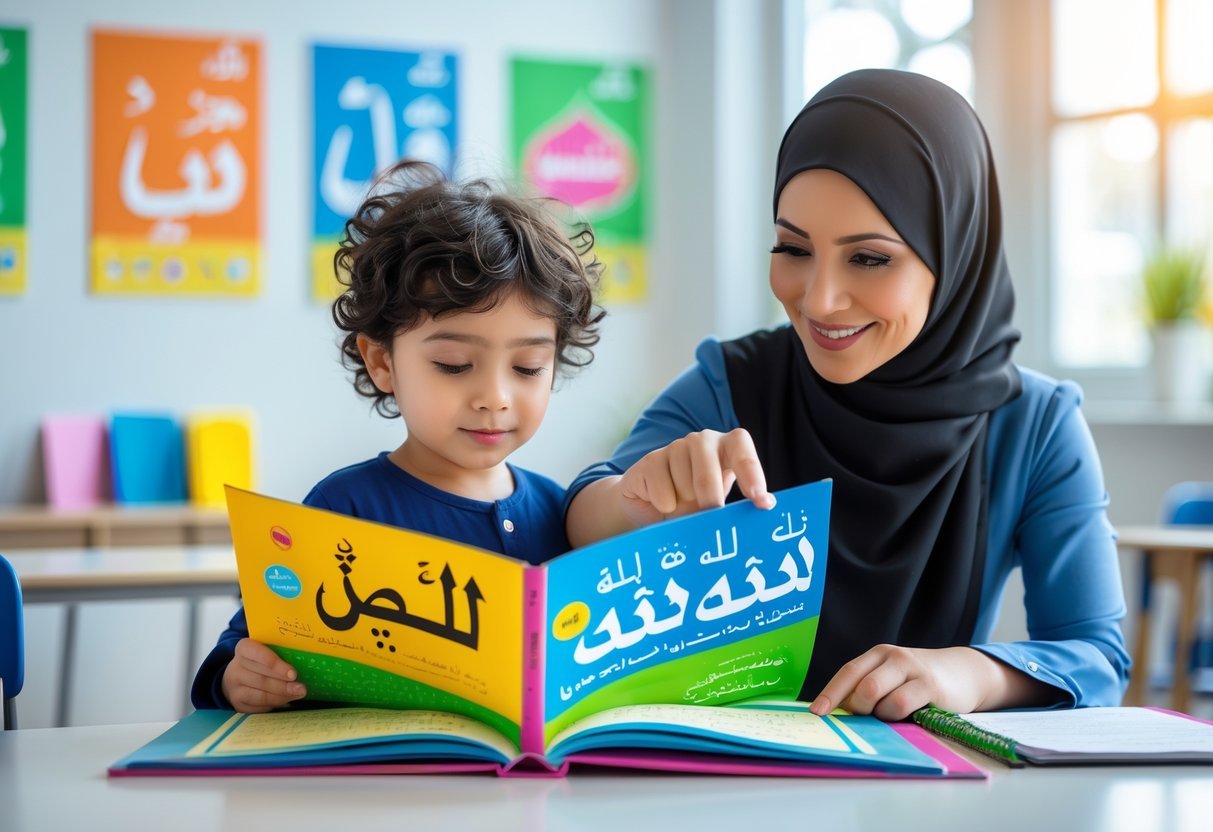
It all starts with the 29 letters of the Arabic alphabet. Students learn each letter’s unique shape and sound, which is crucial—one small difference can change a word’s meaning entirely.
Recognising Arabic Letters
The Arabic alphabet has 29 letters that form the backbone of Quran reading. Each one looks different depending on where it appears in a word—beginning, middle, or end.
Noorani Qaida is the main tool here. It introduces letters systematically, from Alif to Yaa.
Teachers show students how to write each letter. Tracing helps build muscle memory and recognition skills, which honestly takes some repetition.
Learning the alphabet usually takes 8-10 lessons, but there’s no rush. Students move at their own speed to really get it down before moving on.
Practicing Letter Sounds
Each Arabic letter makes a specific sound, and students need to get these right. Proper pronunciation is the foundation for accurate Quran recitation.
Practice focuses on Makharij—the points in the mouth or throat where each letter’s sound is formed. Some Arabic sounds don’t even exist in English, which can be tricky at first.
Teachers demonstrate mouth and tongue positions for tough letters like ح (Haa) and خ (Khaa). Students repeat these until they sound right—sometimes it takes a while, and that’s okay.
There’s extra focus on heavy and light letters. Heavy letters like ط (Taa) and ص (Saad) need fuller pronunciation than lighter ones.
Students record themselves to track progress. Regular practice is key to developing the right muscle memory for these sounds.
Differentiating Similar Letters
Some Arabic letters look almost identical but sound completely different. Students learn to spot the differences—sometimes it’s just a dot that changes everything.
Challenging pairs include ب (Baa) and ت (Taa), which only differ in dot placement. ح (Haa) and خ (Khaa) have the same shape but different dots.
Writing exercises and memory tricks help students tell these apart. Teachers often share little tips to make it less confusing.
The difference between حَلَّ (he solved) and هَلَّ (he destroyed) is a good example—one dot, totally different meaning.
Matching games and identification activities make this part a bit more fun. It helps keep students engaged while building their recognition skills.
Phase 2: Introduction to Tajweed

Tajweed is what turns basic reading into beautiful, correct recitation. Students learn pronunciation rules and get a lot of practice—confidence comes with time.
Essential Tajweed Rules
Tajweed makes sure every letter gets its proper sound. For beginners, the big ones are Makharij (articulation points)—where each letter’s sound starts in the mouth or throat.
Noon Sakinah and Tanween are foundational rules. They apply when the letter noon has no vowel or when tanween comes before other letters.
| Rule | Description | Example |
|---|---|---|
| Izhar | Clear pronunciation | Before throat letters |
| Idgham | Merging sounds | With specific letters |
| Iqlab | Changing to Meem | Before letter Baa |
| Ikhfaa | Partial hiding | With remaining letters |
Qalqalah gives a bouncing sound to five letters: ق، ط، ب، ج، د. Madd teaches when to stretch vowel sounds. Ghunna adds a nasal touch to certain letters.
Importance of Correct Pronunciation
Getting pronunciation right preserves the Quran’s original message. Even a small mistake can change meaning—sometimes in ways you wouldn’t expect.
For instance, “قَلْب” (heart) and “كَلْب” (dog) differ by just one letter. That tiny slip completely changes the verse.
Allah tells us in Surah Al-Muzzammil to recite with measured recitation—scholars say this means using proper Tajweed.
When students recite correctly, they honor Allah’s words and join a tradition that goes all the way back to the Prophet. It also helps avoid confusion or misunderstandings about Islamic teachings.
Practical Tajweed Exercises
Students start with simple letter recognition. They practice feeling where sounds form in the mouth or throat—sometimes it’s more physical than you’d expect.
Color-coded Quran practice is a helpful tool. Different colors show where to apply specific rules, making things a lot clearer for beginners.
Daily listening exercises train the ear. Students follow along with qualified reciters and repeat verses until it feels natural.
Practicing short surahs, like Al-Fatiha, helps students apply rules in real context. It’s a practical, hands-on way to reinforce lessons.
Recording recitations and comparing with experts helps students spot their mistakes. Self-assessment is surprisingly effective for building awareness.
Partner sessions are encouraged, too. Reciting for each other and giving feedback builds confidence and makes the process a bit less intimidating.
Phase 3: Reading and Understanding Short Surahs

Students move on to reading short surahs with Tajweed, building fluency as they go. Along the way, they learn the meanings behind verses and discover the spiritual rewards of good recitation.
Surah Al-Fatiha Practice
Surah Al-Fatiha is at the heart of daily prayers. Students go through each verse step by step, focusing on pronunciation and Tajweed.
This opening chapter has seven verses, recited in every unit of salah. Teachers guide students through articulation and vowel sounds, making sure nothing gets skipped.
Al-Fatiha is packed with Tajweed rules—like Madd, Ghunnah, and knowing where to pause between verses. Practice here sets the tone for all future recitation.
Instructors also explain the meaning of each verse. Students see they’re not just reading words—they’re praising Allah, seeking guidance, and asking for the straight path.
With regular practice, students gain confidence. Reciting the surah smoothly, without hesitation, feels like a real achievement.
Common Short Surahs
The final chapters of the Quran are honestly great for beginners. Short surahs like Al-Ikhlas, Al-Falaq, and An-Nas use simple vocabulary and have clear pronunciation patterns.
Most students start with Surah Al-Ikhlas. It has just four verses and teaches the oneness of Allah with straightforward Arabic words.
After that, they move on to Surah Al-Asr and Surah Al-Kawthar. These surahs let students practice Tajweed rules in new ways and help build up reading speed.
Teachers then introduce the “Four Quls”—the four protective chapters that all begin with “Qul” (Say). Students usually learn Al-Kafirun, Al-Ikhlas, Al-Falaq, and An-Nas for daily protection prayers.
Each surah gets its own practice time. Students focus on smooth transitions between words and learn to control their breath, especially in longer verses.
Meaning and Rewards in Recitation
Understanding what you’re reading turns recitation from a routine into real worship. Students pick up basic translations of the short surahs they’re learning.
Teachers explain that every letter from the Quran earns ten rewards from Allah. Knowing this, students tend to recite with more care and attention.
Some chapters come with extra benefits. For example, Surah Al-Ikhlas is said to equal one-third of the Quran in reward, and Ayatul Kursi is recited for protection.
Proper Quran recitation also involves respect and a bit of preparation. Students learn to do ablution, face the Qiblah, and recite with focus and humility.
As they connect sound with meaning, the experience becomes more spiritual. Slowly, students start to feel the beauty in Arabic pronunciation and the messages behind the words.
Phase 4: Practical Quran Application and Daily Duas

Students learn essential daily supplications and start building habits for using Quranic teachings in everyday life. This phase focuses on recitation etiquette and helps boost confidence in living out Islamic principles.
Reciting Daily Supplications
Students work on mastering essential duas for daily life. The Quran teacher guides everyone through Ayatul Kursi, the four Quls, and morning and evening supplications.
Each dua gets special attention for pronunciation and meaning. Students practice Surah Al-Fatiha until they’re fluent, and also learn protective verses like Surah Al-Falaq and Surah An-Nas.
Essential Daily Duas Covered:
- Morning and evening remembrance
- Dua before meals and sleep
- Travel and protection supplications
- Quranic verses for daily recitation
The Islamic studies piece helps students know when and why to use each dua. Regular practice means students can eventually recite these from memory, without much hesitation.
Audio recordings are shared so students can practice at home. Teachers give feedback on common mistakes and how to fix them.
Applying Quran in Daily Life
Practical application is where things really come alive. Students learn how to use verses and teachings as part of their routines and decisions.
The course encourages reflecting on verses instead of just reading them. Students pick one verse a day, think about its real-life meaning, and discuss it with family for deeper understanding.
Daily Application Methods:
- Choose verses that relate to current situations
- Practice patience using Quranic guidance
- Apply honesty and kindness principles
- Use Quranic supplications during challenges
Combining Quran recitation with dhikr and personal duas helps deepen spiritual connection. The Islamic studies side gives context to different verses and why they matter.
Teachers encourage students to share their reflections. It’s a good way to build confidence and reinforce what’s learned.
Etiquette of Quran Recitation
Proper etiquette shows respect for the sacred text. Students learn both the physical and spiritual preparations needed for reciting the Quran.
Physical Preparation:
- Perform wudu before touching the Quran
- Face the Qiblah when possible
- Sit respectfully with clean clothing
- Hold the Quran with both hands
Staying focused is important. Students learn to avoid distractions and find quiet spaces for study.
The teacher demonstrates how to sit and handle the mushaf. Students keep practicing until it feels natural.
Recitation Guidelines:
- Begin with A’udhu billahi and Bismillah
- Recite slowly with clear pronunciation
- Listen to themselves while reciting
- End with appropriate duas
Connecting this to salah preparation helps students see the bigger picture of Islamic etiquette. These habits really do make Quranic engagement more meaningful.
Phase 5: Graduation and Certification

Students reach the last big step in their Quran reading journey with assessments and official recognition. This phase helps ensure everyone keeps up proper etiquette and respect for the Quran in daily life.
Live Recitation Assessments
Students take part in one-on-one classes with qualified teachers for their final tests. These sessions let instructors check pronunciation, Tajweed, and overall reading fluency.
The assessment covers all previous phases:
- Arabic alphabet recognition and pronunciation
- Tajweed rule implementation
- Short surah recitation with proper rhythm
- Daily duas and practical verses
Teachers give personalized feedback during these sessions. If students need to work on anything, they get guidance before certification.
Multiple assessment opportunities mean no one’s left behind. Anyone needing more practice can book extra sessions—no pressure.
The live setup helps teachers see that students can recite confidently, without relying on written aids. It’s about building real skills that last.
Ijazah (Certification) Process
UK Quran Academy awards an official Ijazah certificate to students who complete all requirements. This certificate officially recognizes their Quran reading skills.
The certificate includes:
- Student’s name and completion date
- Confirmation of Tajweed proficiency
- Authorization to teach basic Quran reading
- Academy’s official seal and instructor signature
Digital and physical copies are given to all graduates. The certification is respected in Islamic educational circles across the UK.
Students wanting to go on to hifz (Quran memorization) get priority. Their strong reading and Tajweed foundation sets them up well for advanced studies.
The Ijazah isn’t just about academics. It connects students to a long tradition of Islamic scholarship.
Maintaining Respectful Quran Practice
Graduates pick up key habits for lifelong Quran recitation. These practices help keep respect for the holy text at the center.
Physical preparation means performing wudu before reciting. Facing the Qiblah and sitting in a clean, quiet spot are also part of it.
Mental preparation involves making a sincere intention before starting. Graduates are encouraged to recite with focus and not just rush through verses.
Proper handling includes keeping the Quran elevated and stored respectfully. Even digital versions on a phone or tablet deserve the same care.
Teachers remind everyone that quran online learning doesn’t stop with certification. Keeping up regular practice is what keeps skills sharp and the spiritual connection strong.
Students learn how to teach family and friends, too. This way, Quranic knowledge keeps spreading in the community.
Benefits of Quran Learning with UK Quran Academy

UK Quran Academy offers meaningful spiritual growth, flexible options for busy lives, and expert teaching for kids and adults at all levels.
Spiritual and Personal Growth
Learning here helps students connect more deeply with their faith. The academy’s structured approach makes it easier to understand the sacred text and develop recitation skills.
Guided learning with qualified instructors brings real spiritual growth. Each lesson focuses on pronunciation and meaning, letting students appreciate the beauty of Quranic verses.
The academy puts a lot of emphasis on Tajweed rules. Reciting with proper pronunciation brings the spiritual rewards taught in Islam.
Personal development comes naturally as students move through lessons. They gain confidence in reading and build discipline with regular practice.
Plenty of students say they feel more connected to their daily prayers after finishing a course. The academy’s method makes learning feel achievable and even enjoyable.
Flexible and Supportive Learning
UK Quran Academy has online classes that fit around busy schedules. Families pick lesson times that work with school and work commitments.
There’s one-on-one instruction with certified tutors. This kind of attention means every student gets the support they need.
Learning from home is easy—just use Skype or another online platform. No need to travel anywhere for lessons.
Expert instructors guide students through each step. Teachers are fluent in English and really get the needs of UK-based learners.
Trial sessions are available, so families can see if the teaching style fits before signing up. It’s a nice way to make sure students feel comfortable and supported.
Learning for All Ages and Levels
The academy welcomes both children and adults who want to learn Quran reading. Quran classes for kids use age-appropriate teaching methods that help keep young learners interested.
Adult beginners get patient instruction that matches their pace. No previous Arabic experience? That’s totally fine—the curriculum starts from scratch.
Students move through five clear phases. You’ll start with basic Arabic letters, then gradually work up to advanced recitation skills.
Each phase builds on what you learned before, so it never feels overwhelming. It’s all about manageable steps.
Male and female instructors are available, which is great for families with different preferences. Everyone deserves a comfortable learning environment, right?
The academy hands out certificates when you finish a course. It’s a nice way to recognize your progress and maybe give you that extra push to keep going.
Leave A Comment