

Learning Salah is such a vital part of every Muslim’s path. For families in the UK, finding trustworthy, friendly guidance can feel daunting—there’s just so much out there. UK Quran Academy has designed a namaz course that makes learning prayer straightforward, meaningful, and honestly, a lot less stressful for everyone.

This course walks families, children, and adults through Salah step by step. It mixes Arabic reading with English translations and practical, hands-on support.
Whether you’re taking your first steps in Islam or just want to polish up your prayer, the course builds confidence with expert UK-based instructors who really get the British Muslim experience.
The journey covers basics and goes deeper, from how to prepare for Salah to understanding the meaning behind every Arabic phrase. You’ll practice each movement live, ask questions, and get real feedback.
By the end, learners won’t just know the technical side—they’ll feel a deeper connection with Allah, and maybe even look forward to prayer in a new way.
Why Choose UK Quran Academy for Salah?

UK Quran Academy really stands out for learning Salah. You’ll find expert UK-based teachers, flexible classes made for busy families, and a warm community that genuinely cheers you on.
UK-Based Expert Teachers
UK Quran Academy hires qualified online teachers who understand British Muslim families—because they’re part of that community too. They bring years of experience teaching Salah to all ages across the UK.
There are both male and female online teachers, so everyone feels comfortable. Female students and mums can learn from female teachers who create a safe, supportive vibe.
Quran teachers here speak fluent English and know British culture inside out. They break down Islamic concepts in ways that just make sense for UK families.
Every teacher gets special training in teaching Salah to beginners. They use modern, interactive methods that make learning prayer surprisingly enjoyable for kids and adults.
Support for Families and Children
UK Quran Academy’s courses fit the entire family. Parents and kids can learn Salah together—it’s a great way to build stronger family bonds and, honestly, it just feels good to learn side by side.
Teachers use fun activities and interactive tools for children. Think colourful materials, practice charts, and reward systems that actually keep kids interested.
They know every family learns at a different pace. Some kids pick up Arabic words quickly; others need a bit more patience, and that’s totally fine.
Special attention is given to parents wanting to improve their own Salah. Teachers are patient and supportive, especially with adults who feel a bit shy about starting.
Flexible Online Classes
UK Quran Academy offers one-to-one online classes that fit around busy British family life. You can pick morning, afternoon, or evening slots—whatever works for you.
Classes run all week, including weekends, making it easier for working parents and school kids to join in.
The 30-minute sessions help kids stay focused without losing interest. Adults can opt for 45-minute lessons if they want to dive deeper.
Need to reschedule for a school event or family thing? No problem. The academy gets it—life in the UK is busy.
Welcoming Learning Community
UK Quran Academy creates a non-judgmental space where beginners can ask anything and make mistakes. Teachers encourage students and celebrate progress, even the small wins.
New Muslims are especially welcome. Teachers offer gentle guidance and clear explanations for anyone just starting out.
You’ll join a community of UK Muslim families all working toward the same goal. Friendships and support come naturally here.
Teachers keep in touch with families, sharing updates and tips for practice at home. Parents always know how their children are doing.
Course Objectives

This course’s main goal is to teach students how to perform namaz properly, understand Arabic prayers, and build a genuine spiritual connection with Allah.
Step-by-Step Salah Guidance
Every movement and position in Salah gets broken down. Students learn the right way to stand, bow, and prostrate.
Lessons are simple and clear. Teachers show how to place your hands, where to look, how to move—nothing gets skipped.
Key learning areas:
- Proper body positioning at each stage
- Timing and smooth transitions
- Common mistakes to look out for
- Live practice with instant feedback
Students practice each step several times before moving on. This really helps build muscle memory.
The course covers all five daily prayers and explains how each has a different number of rakats (units).
Understanding Arabic in Prayer
Students memorise essential Arabic phrases for Salah, learning correct pronunciation along the way.
Each Arabic word comes with its English meaning, so you actually understand what you’re saying to Allah.
Core Arabic elements covered:
- Takbeer (Allahu Akbar)
- Surah Al-Fatihah with translation
- Tashahhud and its meaning
- Common duas in prayer
Teachers use simple tricks to help with tricky Arabic sounds. Audio recordings are provided for extra practice at home.
The course also explains why Arabic is used in Salah and why it matters for connecting Muslims worldwide.
Building Spiritual Connection
Salah isn’t just about movements—students learn to focus their hearts and minds too.
Teachers explain the deeper meaning behind each action. Why face Mecca? What does each position represent? It’s all covered.
Spiritual development includes:
- Seeing prayer as a way to talk to Allah
- Learning how to concentrate during Salah
- Recognising Salah as a pillar of Islam
- Building regular prayer habits
The course helps students find peace in prayer and tune out distractions. It also shows how regular Salah can shape good character and link to other parts of Islamic faith.
Encouraging Confidence and Consistency
New learners often worry about getting Salah right. This course is all about practicing in a supportive, low-pressure environment.
Teachers offer patient guidance and real encouragement. They help students tackle common beginner challenges without embarrassment.
Confidence-building methods:
- Lots of practice
- Personal attention from instructors
- Peer support from classmates
- Celebrating progress—no matter how small
Students set their own goals and work out prayer routines that fit real life. By the end, most feel ready to pray on their own, with the confidence to keep going.
Course Structure and Duration

The Namaz Course for Beginners runs as a 6-week programme, with flexible scheduling designed for busy UK families. Online teachers give personalised support, and the materials are made for all ages.
Schedule and Class Frequency
The course lasts 6 weeks with 3 classes a week. Each session runs for 45-60 minutes—enough to learn, not so much that it’s overwhelming.
Classes are timed for UK-friendly hours to suit working parents and kids. Morning, afternoon, and evening slots are up for grabs.
Weekly Schedule:
- Monday, Wednesday, Friday: Core lessons
- Tuesday, Thursday: Optional practice
- Weekend: Catch-up sessions for busy families
Families can pick from different times:
- Morning: 9:00–10:00 AM
- Afternoon: 2:00–3:00 PM
- Evening: 7:00–8:00 PM
The flexible setup means parents and kids can learn together or join age-specific sessions. It’s as relaxed or as focused as you need it to be.
Family-Friendly Accessibility
The course welcomes children from age 6, teens, adults, and elderly learners. Lessons are tailored to each group’s learning style.
Kids get interactive activities, visual aids, and rewards. Adults focus more on detailed explanations and applying what they learn.
Family Package Benefits:
- Discounted rates for multiple family members
- Shared learning resources
- Family prayer practice time
- Parent-child bonding through faith
Teachers adjust their pace for different ages, so grandparents and grandchildren can learn together. It can be a surprisingly special experience.
There’s support for learners with different abilities or needs, making sure everyone gets a fair shot.
Learning Support and Materials
Students get a complete digital learning pack—prayer mats, visual guides, audio recordings, all designed for UK Muslim families.
Included Resources:
- Step-by-step prayer guide with English
- Audio for correct pronunciation
- Weekly practice worksheets
- Interactive prayer mat with cues
- Mobile app for daily reminders
Teachers give one-to-one feedback in group classes. You can ask questions and get instant corrections.
Extra Support:
- Weekly progress updates for parents
- 24/7 access to recorded lessons
- WhatsApp group for quick help
- Monthly family check-ins
Personalised learning plans are made for those needing extra help, while advanced students get extra challenges to keep things interesting.
Introduction to Salah in Islam

Salah is really the backbone of Islamic worship and one of the five pillars. Understanding its meaning, Quranic roots, and daily structure lays the groundwork for truly meaningful prayer.
Meaning and Importance of Salah
Salah—sometimes called Namaz—is direct communication with Allah. It’s the second pillar of Islam, right after Tauheed (belief in one God).
Muslims pray five times a day. This isn’t just a routine; it’s a way to stay connected to Allah, no matter how busy life gets.
The word “Salah” actually comes from Arabic roots meaning “connection” or “contact.” Every prayer session quietly builds that spiritual link.
Key benefits of Salah include:
- Spiritual purification and peace
- Regular remembrance of Allah
- Discipline in daily life
- Community connection when prayed in groups
Salah acts like a reset button for the soul. It helps Muslims keep their faith at the centre, even when life throws curveballs.
Through prayer, you learn patience, humility, and gratitude. These qualities shape your character far beyond the prayer mat.
Quranic Verses and Hadith About Salah
The Quran mentions Salah more than 80 times. Clearly, it’s not something to overlook if you want to understand Islam.
These verses guide Muslims on both timing and method. It’s all laid out so no one feels lost.
Important Quranic verses about Salah:
| Verse Reference | Key Message |
|---|---|
| Surah Al-Baqarah 2:3 | Those who believe in the unseen and establish prayer |
| Surah Al-Ankabut 29:45 | Prayer prevents shameful and wrongful acts |
| Surah Al-Mu’minun 23:1-2 | Successful believers are humble in their prayers |
Prophet Muhammad (peace be upon him) said: “The first thing a person will be asked about on the Day of Judgment is their Salah.”
Another hadith: “When one of you stands in prayer, he is speaking directly to his Lord.” That really highlights how personal prayer is meant to be.
He also called Salah “the light of the believer.” It’s not just ritual—it’s guidance and clarity.
Types and Timings of Salah
There are different types of Salah, each with their own rules and rewards. The daily schedule is pretty set, but there’s flexibility in how you connect with Allah.
The three main types are:
Fardh (Obligatory): These five daily prayers are a must for every Muslim. Skipping them without a valid reason? It’s considered a major sin.
Sunnah (Recommended): These are extra prayers the Prophet Muhammad regularly performed. They bring extra blessings and help deepen your spirituality.
Nafl (Voluntary): These are optional prayers, like night prayers or those for special occasions. They’re a way to get even closer to Allah.
Daily prayer schedule:
- Fajr: Dawn prayer (2 rakat)
- Dhuhr: Midday prayer (4 rakat)
- Asr: Afternoon prayer (4 rakat)
- Maghrib: Sunset prayer (3 rakat)
- Isha: Night prayer (4 rakat)
Each prayer has its own time window, based on the sun’s position. Most people rely on timetables or apps to keep track—there’s no shame in that.
The five daily prayers give your day a steady rhythm. They break up the routine and offer moments to pause, reflect, and reconnect with Allah.
Preparing for Salah

Before praying, Muslims perform ablution (wudhu) and check that all conditions are right for worship. The adhan—the call to prayer—signals it’s time to get ready for this sacred act.
Wudhu (Ablution) Step-by-Step
Wudhu is a ritual wash, purifying both body and mind before prayer. Every Muslim needs to complete these steps before Salah.
Step 1: Make Intention (Niyyah)
Start by quietly making the intention in your heart to perform wudhu for Allah. This mental step matters.
Step 2: Say Bismillah
Say “Bismillahir-Rahmanir-Raheem” (In the name of Allah, the Most Gracious, the Most Merciful).
Step 3: Wash Hands
Wash both hands up to the wrists three times—right first, then left.
Step 4: Rinse Mouth
Take water in your right hand, rinse your mouth three times, and spit it out each time.
Step 5: Clean Nose
Sniff water into your nostrils three times with your right hand, then blow it out with your left.
Step 6: Wash Face
Wash your face three times, from forehead to chin and ear to ear.
Step 7: Wash Arms
Wash your right arm from fingertips to elbow three times, then do the same for the left.
Step 8: Wipe Head
Wet your hands and wipe your head once, front to back.
Step 9: Clean Ears
Use your index fingers for the inside and your thumbs for the back of your ears.
Step 10: Wash Feet
Wash your right foot up to the ankle three times, making sure to get between the toes. Repeat for the left foot.
Conditions for Valid Salah
Certain conditions must be met for Salah to count. These aren’t just rules—they help keep the act meaningful.
Cleanliness Requirements:
- Body must be free from major and minor impurities
- Clothes should be clean and pure
- Prayer space must be tidy
Time Requirements:
Each prayer needs to be done in its correct time window. It’s all about following the sun’s position.
Direction (Qiblah):
Face the Kaaba in Mecca during prayer. If you’re not sure, a compass or a qiblah app can help.
Covering (Awrah):
Men cover from navel to knee; women cover everything except face and hands. It’s about modesty and respect.
Mental State:
Try to be present and focused. Distractions are normal, but the aim is to give Allah your full attention.
Adhan and Iqamah Primer
The adhan is the call to prayer, announcing each prayer time. The iqamah is a quick call right before the prayer actually starts.
Adhan Structure:
It has seven main phrases, each repeated in a set pattern:
| Arabic Phrase | English Translation | Times Repeated |
|---|---|---|
| Allahu Akbar | Allah is Greatest | 4 times |
| Ashhadu an la ilaha illa Allah | I bear witness there is no god but Allah | 2 times |
| Ashhadu anna Muhammadan rasul Allah | I bear witness Muhammad is Allah’s messenger | 2 times |
| Hayya ‘ala as-salah | Come to prayer | 2 times |
| Hayya ‘ala al-falah | Come to success | 2 times |
| Allahu Akbar | Allah is Greatest | 2 times |
| La ilaha illa Allah | There is no god but Allah | 1 time |
Iqamah Purpose:
The iqamah tells everyone the prayer’s about to start. It’s shorter and a bit quicker than the adhan.
Response to Adhan:
When you hear the adhan, repeat each phrase quietly to yourself, except for “Hayya ‘ala as-salah” and “Hayya ‘ala al-falah.” For those, say “La hawla wa la quwwata illa billah” (There is no power except with Allah).
Understanding Arabic Words and Phrases
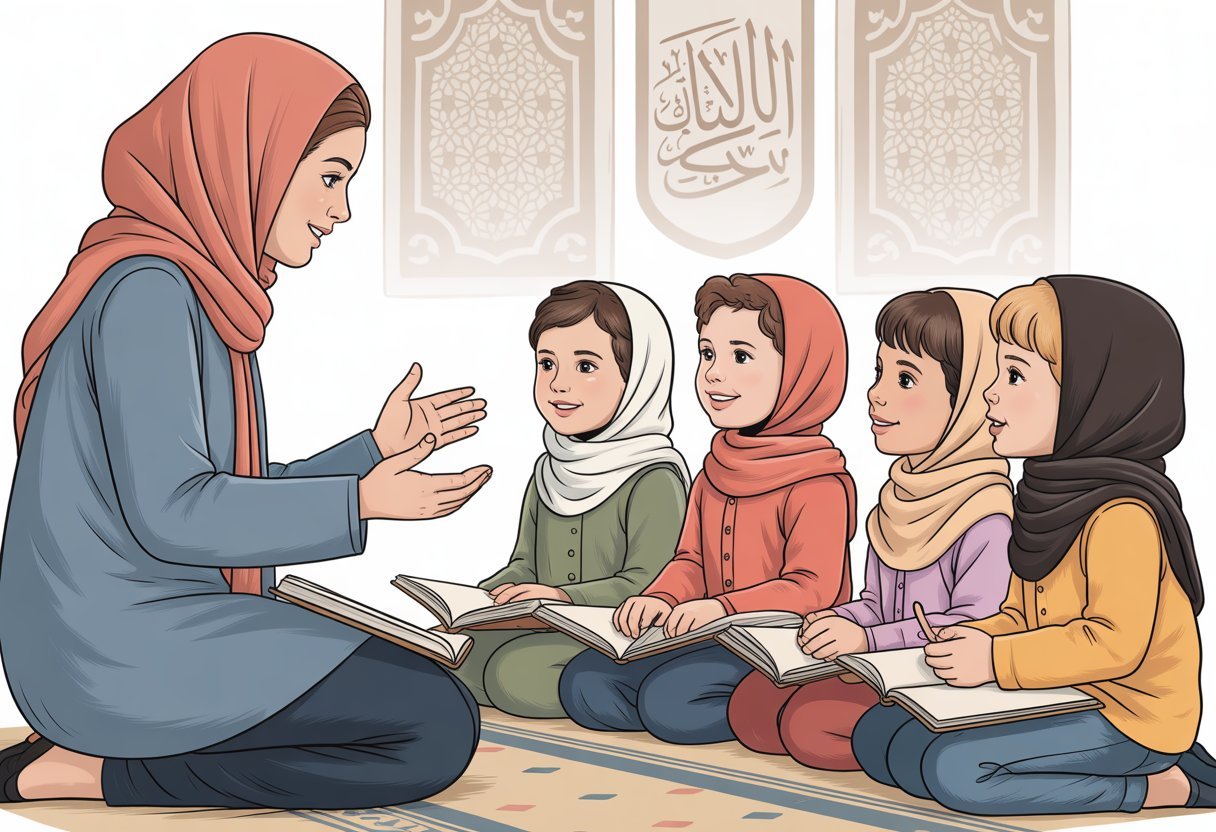
Learning Arabic words and phrases helps beginners actually understand their prayers. It’s a game-changer for building a real connection with Allah.
Key Phrases in Salah
Takbeer means “Allah is the Greatest.” It’s how you start prayer, and you’ll say “Allahu Akbar” at several points. Getting the pronunciation right is part of the learning process.
Subhanaka is the opening du’a, praising Allah. The full phrase means “Glory be to You, O Allah, and praise be to You.” Students usually practise this with their Quran teachers.
Surah Al-Fatihah is recited in every unit of prayer. It’s all about asking Allah for guidance and mercy. Students memorise it verse by verse, learning both words and meaning.
Ruku phrases include “Subhana Rabbiyal Azeem”—”Glory be to my Lord, the Great.” Sujood phrases use “Subhana Rabbiyal A’la,” which means “Glory be to my Lord, the Most High.”
Tashahhud is recited while sitting, declaring faith in Allah and His Prophet. Durood is sending blessings upon Prophet Muhammad (peace be upon him).
Simple Translation and Explanation
Quran teachers break down every Arabic phrase into easy English. For example, “Bismillah” means “In the name of Allah.” That’s how most prayers begin.
“Rabbana lakal hamd” translates as “Our Lord, praise belongs to You.” It’s a way of showing thanks and respect.
The prayer ends with “Assalamu alaikum wa rahmatullahi wa barakatuh”—”Peace be upon you and Allah’s mercy and blessings.” It’s not just words; you’re greeting angels and fellow worshippers.
Teachers use flashcards, audio tools, and visual guides to help with pronunciation and understanding. Seeing Arabic text next to English translations really helps things click.
Benefits of Learning Arabic in Salah
Understanding Arabic words makes prayer way more meaningful. Students feel a real connection with Allah, not just repeating sounds.
Learning phrases boosts confidence. Suddenly, you’re not just reciting—you’re communicating, and that’s empowering.
With regular practice, pronunciation improves. Quran teachers give feedback and tips, which also helps when reading Quran outside of prayer.
Kids especially benefit from learning meanings early. They grow up understanding what they’re saying, and families can pray together with shared knowledge.
Performing Salah Step-by-Step

Learning to perform Salah correctly means knowing both the sequence and the movements. Students practise each position, and mistakes are part of the journey—nobody gets it perfect on day one.
Learning the Movements and Postures
The UK Quran Academy’s namaz course covers seven main positions—these are the backbone of every salah. Students start with Qiyam, standing upright with feet about shoulder-width apart and hands on the chest.
Next up is Takbir. Here, both hands go up to ear level, palms open and facing forward. It marks the official start of prayer—hand position matters more than you might think.
For Ruku (the bowing bit), you bend forward at the waist. Your back stays straight, hands rest on knees, and your head lines up with your spine. Not as easy as it sounds!
Sujood (prostration) is where you get low—seven body parts need to touch the prayer mat: forehead, nose, both palms, knees, and toes. It’s humbling and, honestly, a bit grounding.
Then comes Jalsa, the sitting position between prostrations. You sit on your left foot, right foot upright, toes pointing toward the Qiblah. It’s a subtle detail but makes a difference.
Tashahhud is the final sitting posture. The right index finger moves during certain recitations—if you’ve ever wondered why, there’s a reason behind it.
Every posture connects with specific Arabic recitations. Students pick these up alongside the movements, so it’s not just about form.
Sequence of 2 Rakat Salah
A 2 rakat salah follows a set sequence, and students repeat it until it feels natural. Things kick off with the opening Takbir while standing in Qiyam.
In the first rakat, students recite Surah Al-Fatihah and then a short surah. Once done, it’s into Ruku with its own prescribed words.
After standing up briefly, the first Sujood happens. There are two prostrations, with a short Jalsa (sitting) in between.
The second rakat is basically a repeat—stand, recite, bow, and two prostrations again. The rhythm becomes familiar after a while.
During the final sitting (Tashahhud), students recite special supplications. They send blessings on the Prophet and make a short dua—simple, but meaningful.
To finish, there’s Tasleem: turn your head right and left, saying “Assalamu alaikum wa rahmatullah.” That’s the wrap-up, and it signals the end of the prayer.
Guidance for Common Mistakes
Lots of beginners rush through salah, missing out on proper timing. The course stresses holding each position for at least three seconds—no need to sprint.
Hand placement in Qiyam gets overlooked. Hands go on the chest, right over left—not hanging at your sides or lower down.
Keeping the back straight in Ruku is tricky for some. Teachers show how to bend only at the waist, keeping your head in line with your back.
Incomplete Sujood happens if all seven parts don’t touch the ground. Students learn to check: forehead, nose, palms, knees, toes—all down.
Another common slip? Rushing between movements and skipping recitations. Each posture has its own words, and it’s worth taking the time.
And yes, forgetting the finger movement during Tashahhud crops up a lot. The course makes sure students know when and how to move their finger.
Teachers are patient, offering gentle corrections and extra practice. Mastery comes with time—and a few reminders along the way.
Additional Modules: Beyond the Basics

Once students are confident with the five daily prayers, there’s more to explore. Advanced modules cover extra prayers, what to do when travelling, and how to handle missed prayers. It’s about building a well-rounded understanding of worship.
Introduction to Nawafil and Sunnah Prayers
Sunnah prayers are the extra prayers the Prophet Muhammad (peace be upon him) prayed regularly. They’re not obligatory, but they bring extra rewards and show love for Allah.
Students learn the 12 Sunnah prayers performed daily:
- 2 rakats before Fajr
- 4 rakats before Zuhr
- 2 rakats after Zuhr
- 2 rakats after Maghrib
- 2 rakats after Isha
Nawafil prayers are voluntary—pray them anytime. Popular ones include Tahajjud (late night) and Duha (mid-morning). They’re flexible and can fit around a busy day.
The course explains when these prayers are best performed, and what rewards are mentioned in Islamic teachings. It’s not just about quantity—it’s about intention.
Students get to practice the timings and learn the Arabic phrases used. Teachers show how to fit these prayers into daily routines without feeling overwhelmed.
Funeral, Eid, and Traveler’s Salah
Janazah (funeral) prayer is for Muslims who have passed away. Students learn the four takbirs and the special duas that go with them.
The course covers where and when funeral prayers happen. There’s a sense of duty to attend if you can—it’s a community thing.
Eid prayers are for the two major Islamic festivals. They come with extra takbirs and unique recitations—definitely not your daily routine.
Students learn the difference between Eid al-Fitr and Eid al-Adha prayers. Practising the format, especially the six or seven takbirs in the first rakat, helps it all make sense.
Traveler’s prayer rules make things easier when you’re on the road. If you’re travelling over 48 miles, you can shorten four-rakat prayers to two. Handy, right?
The course also explains how to combine prayers during travel. Students learn when these relaxations apply and when to return to the normal routine.
Covering Missed Prayers (Qadha)
Missing prayers happens—sometimes it’s sleep, illness, or something unavoidable. Qadha prayers let you make up for them.
Students are taught to perform missed prayers as soon as possible. There’s a method for making up multiple missed prayers in the right order, too.
Teachers explain that genuine forgetfulness or illness are valid reasons. Still, delaying prayers without a real reason isn’t encouraged.
The course offers practical tips for catching up on missed prayers. Students learn how to fit qadha into their schedule without missing current prayers.
Special cases like long illness or extended travel get extra attention. Students figure out how to calculate and gradually make up missed prayers over time—it’s not as daunting as it sounds.
Learning Special Duas
Students at UK Quran Academy get to expand their prayer vocabulary with extra duas, not just the basics. These special supplications really deepen their connection with Allah—sometimes in ways you might not expect.
The course covers duas for all sorts of moments. Think morning and evening remembrance, before and after meals, or even when stepping in and out of the house.
- Morning and evening remembrance
- Before and after meals
- Entering and leaving home
- During tough times or when things are going well
Students practise Arabic pronunciation while also learning the English meanings. It’s honestly a relief to know what you’re actually saying in each dua.
Quranic duas—the ones straight from the verses—get a special spotlight. There’s something powerful about memorising the same supplications made by prophets and righteous people.
Teachers hand out printed dua cards and audio recordings, so practice doesn’t stop at the classroom door. Families can join in too, making dua learning feel less like homework and more like a shared journey. (It’s surprisingly fun, actually.)
Leave A Comment