

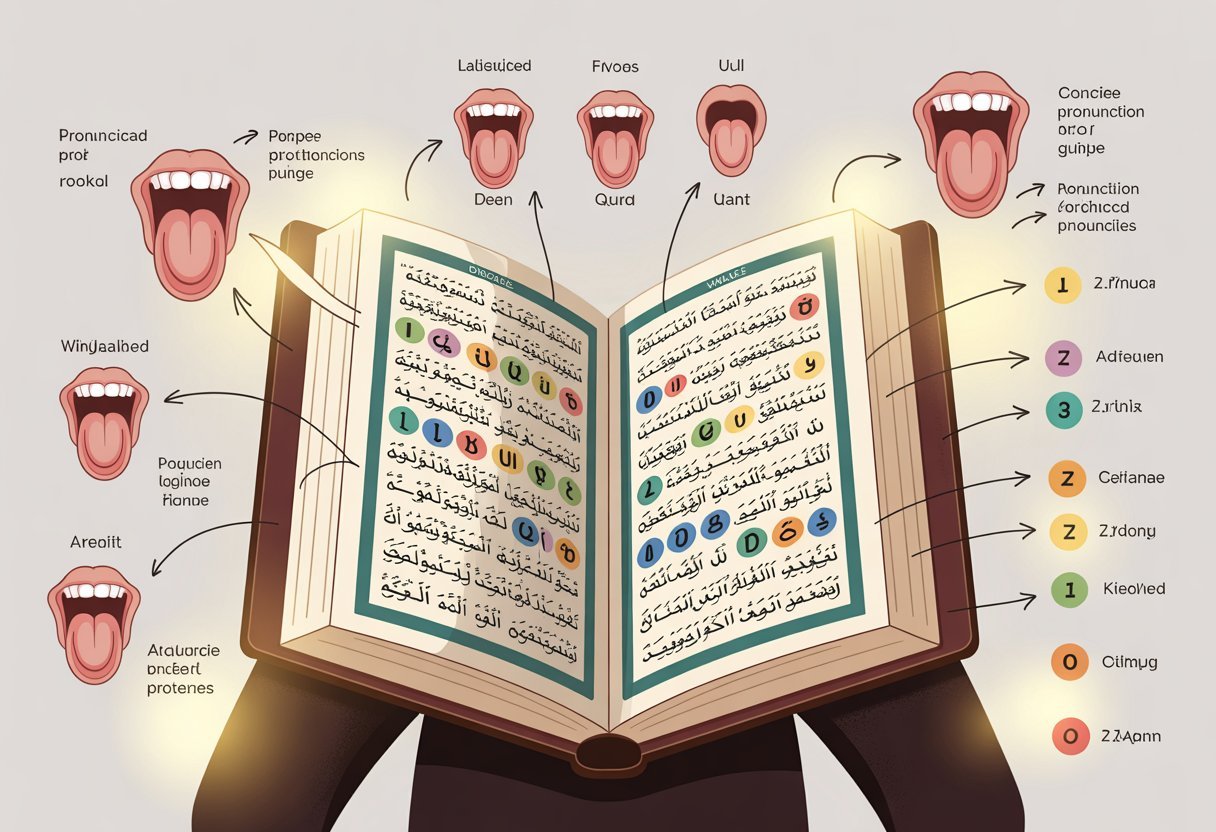
Learning to recite the Quran with proper pronunciation means understanding tajweed. This is the Islamic science that sets the rules for correct Quranic recitation.
Tajweed pronunciation guides give you the essential rules and techniques to articulate every Arabic letter from its correct point of origin, while keeping its unique sound qualities intact.
This ancient discipline preserves the way Prophet Muhammad (peace be upon him) recited the Quran more than 1,400 years ago.
Many Muslims struggle with Arabic pronunciation, mostly because they aren’t sure where the letters come from in the mouth and throat. The tajweed pronunciation guide tackles these challenges by teaching the basics of proper articulation.
These rules make sure each letter keeps its distinct sound and meaning during Quranic recitation.
This guide explores the core principles of tajweed pronunciation, from Arabic letter basics to applying advanced rules in real recitation. You’ll find practical tips for pronouncing tricky Arabic letters, understanding articulation points, and steering clear of mistakes that can affect the beauty and accuracy of your recitation.
And honestly, if you’re looking for a way to really master this, UK Quran Academy is where we step in. We help you memorize the Quran and remember it, with our expert teachers and scholars guiding you to understand and recite it better, every step of the way.
What Is Tajweed and Its Importance

Tajweed is the backbone of correct Quranic recitation. It’s about precise pronunciation rules that keep the Quran’s meaning pure and unchanged.
Understanding what tajweed is, why it matters in recitation, and its wider benefits helps students realize why proper tajweed training is so important for every Muslim learner.
Definition of Tajweed
Tajweed comes from the Arabic root “jawwada,” meaning “to improve” or “to make better.” In Quranic recitation, tajweed means following a complete set of rules of tajweed for proper pronunciation and articulation of every letter.
These tajweed rules make sure each Arabic letter gets its correct sound and qualities. The system covers the specific points where sounds form in the mouth and throat, called makharij.
Key components of tajweed include:
- Letter articulation points (makharij al-huruf)
- Letter qualities (sifat al-huruf)
- Lengthening rules (ahkam al-madud)
- Nasal sound regulations (ghunnah)
Tajweed preserves how Prophet Muhammad (peace be upon him) received and recited the Quran from Angel Jibreel. Without these rules, pronunciation mistakes can totally change word meanings in Arabic.
Why Tajweed Matters in Quran Recitation
Proper tajweed keeps Quranic verses from being misunderstood. Arabic words can change completely with just a small difference in pronunciation.
For example, saying “qalb” (heart) as “kalb” turns it into “dog.” That’s a pretty big difference, right?
The Quran itself commands careful recitation in Surah Al-Muzzammil (73:4): “Recite the Quran with measured recitation.” This verse points straight to the importance of quranic recitation with care.
Tajweed rules keep things consistent across Muslim communities everywhere. Whether you’re learning in London or Cairo, the same pronunciation standards apply.
Benefits of correct tajweed include:
- Preserving divine message accuracy
- Following prophetic example
- Earning spiritual rewards
- Avoiding misinterpretation
A hadith says those who are good at quran recitation are with the honourable angels. Those who struggle but keep trying get double the reward.
Spiritual and Communal Benefits
Tajweed turns quranic recitation into a truly spiritual experience. Correct pronunciation brings a natural rhythm and melody that really touches the heart—both for the reciter and the listener.
Students who master tajweed often feel a deeper connection during prayer and Quran reading. The exact sounds help focus the mind and keep distractions away.
Community benefits include:
- Unified recitation standards in mosques
- Preserved tradition across generations
- Enhanced congregational prayer experience
- Cultural identity maintenance
Learning tajweed builds discipline and patience. You develop careful listening skills and attention to detail—qualities that come in handy in other parts of life, too.
This practice ties modern Muslims directly to 1,400 years of Islamic tradition. Every properly pronounced letter keeps the chain of accurate transmission going, all the way from the Prophet’s time to now.
In the UK, a lot of Muslim families say tajweed study brings generations together. Grandparents, parents, and kids often learn side by side, strengthening family bonds through shared religious learning.
And if you’re looking for support on this journey, UK Quran Academy is all about helping you memorize the Quran, remember it, and really get it—with guidance from our expert teachers and scholars who care about your progress.
Arabic Alphabet Fundamentals for Tajweed

The Arabic alphabet has 29 letters, each needing precise articulation for proper Quran recitation. Every letter comes with its own characteristics, which decide if it should sound heavy or light.
Some unique Arabic sounds need extra attention to keep the meaning clear.
Overview of the Arabic Alphabet
The Arabic alphabet is the starting point for all Quran tajweed learning. Students really need to master the 29 letters before moving on to more advanced tajweed rules.
Unlike English, Arabic letters change shape depending on where they are in a word. Each letter can have up to four forms: isolated, initial, medial, and final.
The noorani qaida method introduces these letters to beginners in a systematic way. This helps students recognize letter shapes and link sounds to symbols more easily.
Key Features of Arabic Letters:
- Right-to-left writing direction
- Connected script in most cases
- Vowel markings (harakat) above and below letters
- No capital or lowercase variations
Learning Arabic gets easier when you know that each letter starts from a specific point in the mouth or throat. These articulation points, called makharij, decide how each sound should be made.
Three letters—alif, waw, and ya—are madd (elongation) letters. These create the long vowel sounds that are so important for proper Quranic recitation.
Differentiating Heavy and Light Letters
Heavy and light letters are a big deal in tajweed training. This classification affects how you pronounce whole words and verses.
Heavy letters (letters of tafkheem) include:
- ص (saad)
- ض (daad)
- ط (taa)
- ظ (dhaa)
- غ (ghayn)
- خ (khaa)
- ق (qaaf)
These require a fuller, deeper sound, with the tongue sitting lower in the mouth. The letters ر (raa) and ل (laam) can be heavy or light, depending on the vowels around them.
Light letters are pronounced with a clearer, thinner sound. Students have to practise telling apart similar letters, like س (seen) (light) and ص (saad) (heavy).
UK Quran Academy always points out that getting heavy and light letters wrong can totally change a word’s meaning. A quick example: صراط (siraat – path) is not the same as سراط if you mispronounce it.
Unique Characteristics of Arabic Sounds
Arabic has sounds you just don’t find in English, so UK learners need some extra practice here. These include ع (ayn), ح (haa), غ (ghayn), and ق (qaaf).
The emphatic letters (ص، ض، ط، ظ) create a deep, resonant sound that affects nearby letters. You have to keep this emphasis going throughout connected speech.
Throat letters come from three different throat regions:
- Deep throat: ء (hamza) and ه (haa)
- Middle throat: ع (ayn) and ح (haa)
- Upper throat: غ (ghayn) and خ (khaa)
The غنة (ghunna) or nasal sound shows up with ن (noon) and م (meem) in certain cases. This creates a humming sound that should last exactly two beats.
Getting these sounds right takes steady practice with a qualified teacher. Every sound adds to the overall beauty and accuracy of Quranic recitation.
And again, this is where UK Quran Academy stands out. We help you memorize the Quran, remember it, and really understand it, with our expert teachers and scholars supporting you all the way.
Articulation Points: Where and How to Pronounce Each Letter
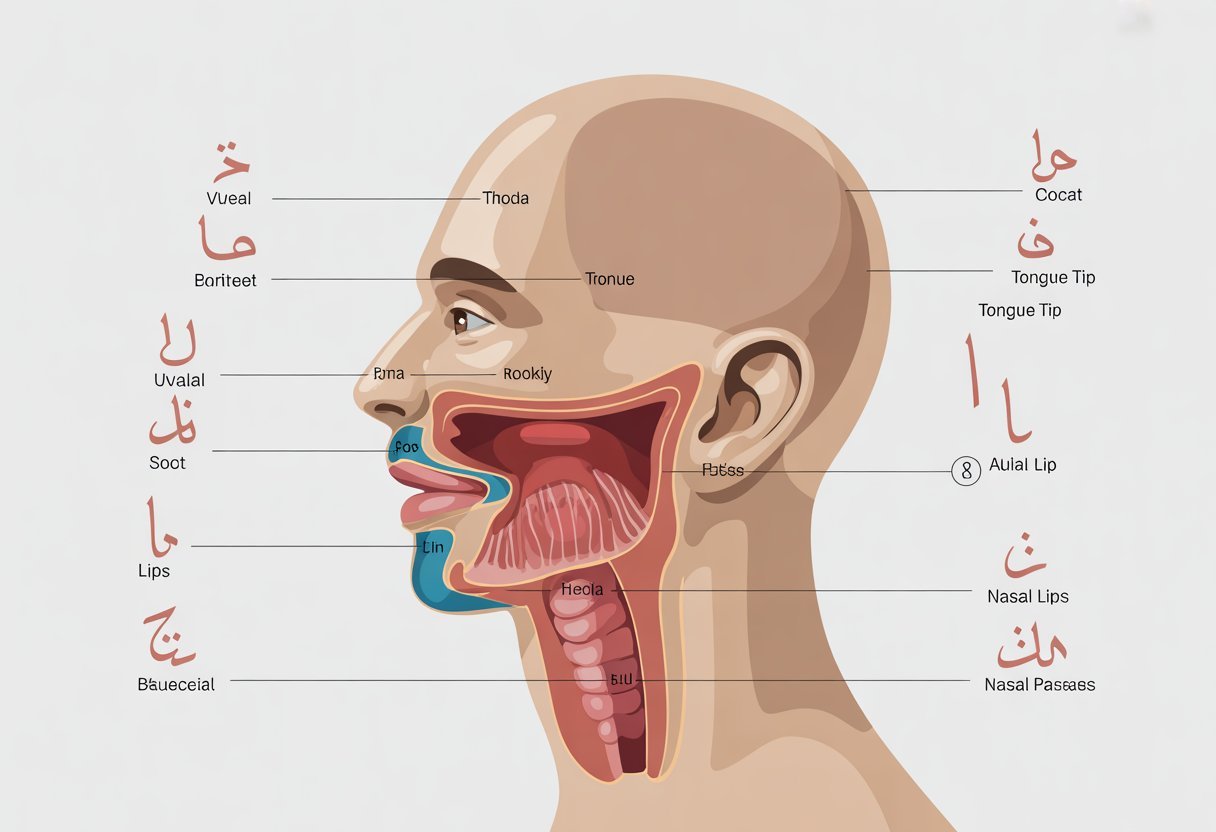
Makharij al-huruf is the foundation of proper Quranic recitation. It’s about the 17 specific points in the vocal tract where Arabic letters start.
Knowing these articulation points helps you master the exact pronunciation of each letter, from alif to qaaf.
Makharij al-Huruf Explained
The vocal tract has five main areas for Arabic letters: the throat, tongue, lips, nasal passages, and the cavity of the mouth.
The throat (al-halq) produces six letters, including haa, ain, and the glottal stop. You need to distinguish between the deep throat sounds and the lighter ones.
The tongue (al-lisan) produces most of the letters in Arabic. It’s got several sections, each making different sounds. The tip handles letters like lam, raa, and noon.
The lips (ash-shafatayn) work together for sounds like ba, meem, and faa. Some need both lips, others use the lip and teeth.
The nasal passage (al-khayshoom) adds a nasal quality to certain letters. This is especially important for advanced tajweed rules.
The space between the throat and mouth is where the three long vowel sounds are produced, giving natural extension to pronunciation.
Common Letter Articulation Examples
UK Quran Academy teaches students to focus first on letters that are often mispronounced. The letter ba needs full lip closure, then a quick release of air.
Haa comes from the middle throat, with a gentle breath. It’s not the same as the English ‘h’—that’s much lighter.
Dhaa uses the tongue tip against the upper teeth. The tongue should touch lightly, letting the air flow through.
Jim is made by pressing the middle of the tongue against the roof of the mouth. It’s not quite like the English ‘j’ sound.
Qaaf comes from the deepest part of the throat. This one’s heavy and emphatic—takes some getting used to.
Raa needs the tongue tip to vibrate against the roof of the mouth. The rolling motion should be controlled and clear.
Honestly, if you’re feeling a bit lost with all these details, you’re not alone. That’s exactly why UK Quran Academy is here—to help you memorize the Quran, remember it, and pronounce every letter accurately, with hands-on guidance from our expert teachers and scholars.
Practice Techniques for Beginners
As a beginner, just finding each articulation point—without even making a sound—can be a challenge. Try placing your tongue or lips in the right spot and holding them there for a moment.
Using a mirror makes a surprising difference. You can actually see the way your mouth and tongue move, especially when comparing letters like meem and faa.
Slow repetition is underrated for building muscle memory. Say each letter ten times, slowly, before you even think about speeding up.
UK Quran Academy suggests recording yourself during practice. It’s a bit awkward at first, but listening back and comparing with your teacher’s pronunciation is eye-opening.
Don’t skip breathing exercises. They help strengthen the muscles you use for reciting, and honestly, better breath control makes everything sound clearer.
Practicing with a partner is underrated. Sometimes, someone else catches mistakes you’d never notice on your own.
Keep listening to certified reciters. It’s the gold standard for pronunciation—just let the correct sounds sink in through repetition.
UK Quran Academy helps you move through these techniques step by step, with expert teachers guiding you on how to memorize and remember the Quran more effectively. Our scholars make sure you’re not just repeating, but actually understanding what you recite.
Core Tajweed Rules for Correct Pronunciation
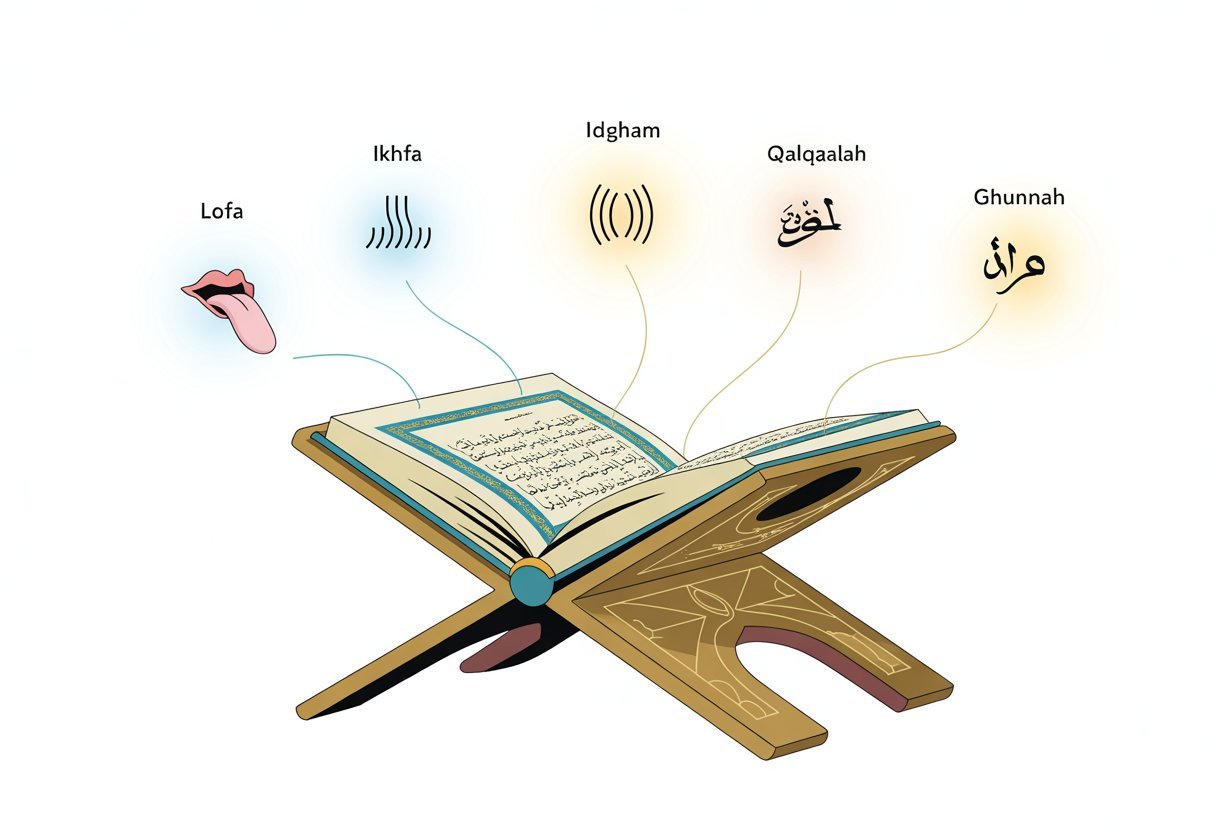
If you want to recite the Quran properly, you’ve got to get three things down: the weight of Arabic letters, the nasal sound called ghunnah, and those rules for noon and meem when they don’t have vowels.
Heavy and Light Letters in Detail
In tajweed, Arabic letters are either heavy or light. This isn’t just for show—it changes how the letters sound when you recite.
Heavy letters are ص، ض، ط، ظ، غ، خ، ق, and sometimes ر. These need a deeper, fuller sound, coming from the back of your mouth.
Most of the other letters are light letters. They’re produced at the front of your mouth and sound clearer, almost brighter.
Take ر (raa) for example—it can be heavy or light. With fatha or dhaa, it’s heavy; with kasra, it’s light. Simple in theory, trickier in practice.
Even ل (laam) in Allah’s name changes. It’s heavy after fatha or dhaa, but stays light after kasra.
At UK Quran Academy, we drill these differences through repetitive exercises. It’s not just about sounding pretty—the meaning can change if you get it wrong.
Ghunnah: Mastering the Nasal Sound
Ghunnah is that nasal buzz you hear with certain letters. It lasts for about two beats, and it’s a big deal in tajweed.
You’ll hear ghunnah naturally with م (meem) and ن (noon) most of the time. The trick is letting the sound resonate through your nose, not your mouth.
There are a few tajweed situations where you need perfect ghunnah:
- If noon sakinah meets certain letters
- During idghaam with ghunnah
- When meem sakinah is followed by another meem
Don’t force it, though. Ghunnah should flow naturally—no pinching your nose or exaggerating.
Getting the timing right is tough at first. UK Quran Academy instructors show you exactly how long two beats should feel, using real examples.
Try this: put your hand near your nose as you recite. If you feel a gentle vibration, you’re on the right track.
Rules for Noon and Meem Sakinah
Noon and meem sakinah—meaning they don’t have vowels—follow their own pronunciation rules when they meet other letters.
Noon sakinah rules include four main categories:
| Rule | Application | Example |
|---|---|---|
| Izhar | Clear pronunciation before throat letters | من أمن |
| Idghaam | Merging with specific letters | من يقول |
| Iqlab | Converting to meem before baa | من بعد |
| Ikhfaa | Hidden pronunciation with remaining letters | من تحت |
Meem sakinah has three rules:
- Izhar before all letters except meem and baa
- Idghaam when there’s another meem after it
- Ikhfaa when baa comes next
These rules help every letter transition smoothly. They also change how long and strong each sound is.
With UK Quran Academy, you get detailed practice on each rule. Our teachers break down every step, and you repeat with them until it sticks.
Pronouncing Challenging Arabic Letters
Let’s be honest—some Arabic letters are just plain tough for English speakers. Deep throat sounds like ain and haa, the rolling raa, and pairs that sound almost the same but aren’t… they all take real work.
Deep Throat and Guttural Sounds
The letters ain (ع) and haa (ح) come from the middle of your throat. English doesn’t really have these, so UK learners often struggle.
Ain (ع) comes from the pharynx. Try tightening your throat muscles just a bit, creating a slight constriction in the middle of your throat. Don’t let it slip into a regular vowel sound.
Haa (ح) is from the same area but softer. Imagine fogging up a mirror with a breath—that’s the feel you want.
Qaaf (ق) is another tricky one. It comes from the back of your tongue, pressing up against the roof of your mouth. Don’t confuse it with English ‘k’—qaaf is deeper and needs more throat action.
Work on these letters by themselves before adding them into words. UK Quran Academy recommends starting with isolated sounds and only moving to syllables when you’re ready.
Rolling and Bouncing Sounds
Raa (ر) is a classic stumbling block. Your tongue tip has to vibrate or roll against the roof of your mouth—not easy if you’ve never done it.
The trick is to place your tongue just behind your upper teeth, then push air so your tongue vibrates. Don’t force it—start with a light tap and work up to a roll.
Dhaa (ظ) is another letter that needs attention. The tongue tip touches your upper teeth and you make a deep ‘th’ sound. It’s easy to mix this up with other sounds if you’re not careful.
Practice these letters in short, focused sessions. It’s better to do a little each day than try to cram for hours.
Similar-Sounding Letter Pitfalls
Some Arabic letters sound almost identical to English speakers, but getting them wrong can change the meaning entirely. These subtle differences really matter.
Haa (ه) and haa (ح) are a classic example. One comes from the entrance of your throat and is barely constricted, while the other needs much more tightening in the middle.
Then there’s Faa (ف). It looks like English ‘f’, but you’ll need to press your lower lip against your upper teeth more firmly than you would in English.
Jim (ج) can also trip you up. In classical Arabic, it’s a soft ‘j’ from the middle of your tongue. English speakers sometimes make it too harsh.
Common pitfalls include:
- Using English equivalents for throat letters
- Saying the English ‘r’ instead of Arabic raa
- Mixing up letter pairs
- Applying English tongue positions to Arabic sounds
At UK Quran Academy, we make you practice these pairs side by side. It’s the only way to really hear—and feel—the difference.
Applying Tajweed in Quran Recitation

Getting tajweed right isn’t a one-and-done thing. You need regular practice, a bit of patience, and a good grip on pausing rules. Noorani Qaida is still the go-to for starting out, giving you a solid foundation for reciting the Quran with confidence.
Quranic Recitation Practice Tips
Make daily practice a habit. Even 20 minutes a day can move you forward faster than you’d expect.
Start with short verses. Build up your confidence before jumping into longer passages.
Begin every session with Surah Al-Fatiha. Focus on applying tajweed rules, even if it feels slow.
Record yourself sometimes. It’s a bit cringey, but you’ll hear things you missed while reciting.
Work on one tajweed rule at a time. Maybe spend a week on Izhar, then move on to Idghām. Don’t rush it.
Some practical techniques:
- Recite slowly and clearly (tarteel style)
- Repeat tough verses until they feel comfortable
- Use a mirror to check your mouth movements
- Schedule regular sessions with a qualified teacher
At UK Quran Academy, we’re all about consistency. Our tajweed programs are designed to keep you practicing every day, with expert teachers and scholars supporting you. We help you memorize the Quran, remember it, and—maybe most importantly—understand it in a way that sticks.
Waqf: Rules of Pausing
Waqf is all about knowing where to pause when you’re reciting the Quran. These pauses help keep the meaning clear and give you natural spots to breathe.
Mandatory pauses (Waqf Lazim) show up at certain marked spots. You really need to stop at these, or you might miss the point of the verse.
Permissible pauses (Waqf Ja’iz) are more flexible. You can pause here if you need to catch your breath, and it won’t change the meaning.
Forbidden pauses (Waqf Mamnu’) are the ones to avoid. Stopping here can mess up the meaning, usually because it’s right in the middle of a phrase.
Waqf symbols you’ll see:
- مـ (Meem) – Mandatory stop
- ج (Jeem) – Permissible stop
- لا (La) – Forbidden to stop
- ص (Sad) – Preferred to stop
Getting a grip on these waqf rules makes your recitation smoother and more meaningful. You’re not just reading—you’re respecting the structure and spiritual message of the Quran.
Effective Use of Noorani Qaida
Noorani Qaida is the go-to book for learning Arabic letters and the basics of tajweed. It’s a step-by-step guide that lays down a solid foundation for reciting the Quran.
You start with recognizing each letter on its own. Then, you learn how to pronounce them correctly—getting the makhraj, or articulation point, just right.
After that, you move on to combining letters. It’s a slow and steady process, so you don’t get overwhelmed by all the rules at once.
Practice in Noorani Qaida looks like this:
- Single letter drills
- Vowel movement patterns
- Applying basic tajweed rules
- Short word combinations
UK Quran Academy weaves Noorani Qaida into every learning program. We make sure you finish the Qaida before tackling the Quran itself, so your pronunciation is spot-on from the start.
It’s a good idea to review old lessons regularly—maybe every week—so you don’t forget the basics as you move forward.
Learning Tajweed: Best Practices and Resources

Getting tajweed right isn’t something you can rush. It takes a structured approach, some real guidance, and a few months of steady practice. UK Quran Academy offers online Quran classes with teachers who really know their stuff—especially when it comes to tajweed for UK learners.
How to Learn Tajweed for Beginners
If you’re just starting, focus on the sounds of Arabic letters and where they’re pronounced. Don’t try to learn every rule at once—go step by step.
Here’s how the journey usually looks:
Foundation Phase (Months 1-2)
- Get comfortable with each Arabic letter
- Figure out the right mouth positions
- Do daily pronunciation exercises
Rule Application Phase (Months 3-5)
- Learn rules like Izhar and Idghām
- Apply them to short verses
- Handle one rule at a time
Integration Phase (Months 6-9)
- Mix several rules in longer passages
- Work on rhythm and flow
- Get feedback and keep practicing
Try to carve out 30-45 minutes each day for practice. At UK Quran Academy, our courses are built around these phases so you can make steady progress without burning out.
Importance of a Qualified Teacher
Honestly, having a real teacher makes all the difference. Sure, you could try to learn on your own, but you won’t catch your own mistakes the way an expert can.
Teachers bring a lot to the table:
Real-time Error Correction
They spot your pronunciation slips right away and show you how to fix them. You just can’t get that from a book or app.
Personalised Learning Plans
Everyone learns differently. A good teacher adapts their approach to fit your pace and your strengths.
Cultural Context and Motivation
Let’s be real—learning Arabic in the UK has its own challenges. Our experienced teachers at UK Quran Academy get that, and they’re there to encourage you and put things in context.
All our teachers are certified in tajweed and understand what British students need. With UK Quran Academy, you get expert help to memorize, understand, and recite the Quran in a way that really sticks.
Thinking about memorizing the Quran? UK Quran Academy is here to help you every step of the way. Our expert teachers and scholars know how to break down memorization into manageable pieces, so you can remember and understand the Quran deeply—even if you have a busy schedule or feel a bit hesitant. We’ll support you with revision plans, encouragement, and practical tips, making the journey feel possible and rewarding. Give it a try—you might surprise yourself.
Online Quran Classes and Support
Online Quran classes open up a world of flexible learning. With just a laptop or phone, you can connect to qualified tajweed teachers without leaving your living room.
Key Features of Quality Online Classes:
- Live Interactive Sessions: Get instant feedback as you recite, so you know what to work on next time.
- Recorded Lessons: Struggling with a tricky rule? You can replay lessons as many times as you need.
- Progress Tracking: Regular check-ins and assessments help you see how far you’ve come.
- Flexible Scheduling: Classes are arranged to fit around your life—work, family, all of it.
Technology Tools That Enhance Learning:
- Clear audio lets you really hear every detail of pronunciation.
- Screen sharing makes it easy to follow along with visual explanations.
- Lesson recordings mean you can practice whenever you want.
- Interactive whiteboards bring Arabic text to life in a way that’s actually engaging.
UK Quran Academy takes all these features and combines them with a team of expert teachers and scholars. We don’t just teach; we help you memorize the Quran and truly remember it.
Our instructors are passionate about helping you understand each verse, not just recite it. We know that memorizing the Quran is a journey, and sometimes you need that extra encouragement or a new approach to make it stick.
At UK Quran Academy, you’ll get practice materials, homework, and regular progress reviews. We’re here to support you every step, making sure you build solid tajweed skills and a deep connection with the Quran.
Leave A Comment