

When you start to recite the Quran properly, you might find yourself asking about the specific rules that guide correct pronunciation and articulation. Tajweed rules are a set of guidelines for Muslims, helping them recite the Quran with precise pronunciation, timing, and articulation—just as it was revealed to Prophet Muhammad (peace be upon him).
These rules keep every letter and word sounding authentic and true to its meaning. It’s honestly amazing how much clarity Tajweed brings to recitation.

The science of Tajweed covers detailed guidance for letter pronunciation, vowel elongation, and when to pause. Once you start learning these, simple reading turns into something melodic and beautiful—something that really honours the Quran.
The rules explain where each sound comes from in the mouth and throat, and how letters blend together as you recite. Sometimes, it’s the tiniest detail that makes the biggest difference.
We’re going to break down the key principles of Tajweed here, making the complex stuff more manageable. You’ll find out about articulation points, letter characteristics, and the rules that are crucial for proper Quranic recitation.
There’ll also be some practical advice along the way, because let’s be honest—practice is everything with Tajweed.
What Are Tajweed Rules?

Tajweed rules provide a system for correct Quran recitation. They cover precise letter articulation, proper pauses, and how to stretch certain sounds.
Definition of Tajweed
Tajweed comes from the Arabic root "jawwada," meaning "to make excellent" or "to improve." In Islam, it’s all about reciting the Quran with beautiful, accurate pronunciation.
It’s a set of rules for how each Arabic letter should sound, making sure every letter comes from its right spot in the mouth or throat. Without this, recitation just wouldn’t be the same.
Tajweed rules cover a few main areas:
- Letter pronunciation from the correct spot
- Sound qualities like thickness or thinness
- How to stretch vowels
- Merging or hiding certain letter pairs
This science keeps the original way of reciting, as taught by Prophet Muhammad (peace be upon him), alive. It’s honestly the reason the Quran sounds the same, no matter where you hear it in the world.
Objectives of Tajweed
The main goal of Tajweed is to preserve the Quran’s original pronunciation. This way, no meanings are lost or changed by accident.
Spiritual Enhancement
Reciting with Tajweed makes the Quran sound more beautiful and uplifting. There’s a special rhythm and flow that just feels right.
Meaning Preservation
In Arabic, a small mistake can change a word’s meaning. Tajweed keeps these mistakes at bay by setting clear pronunciation rules.
Community Unity
Thanks to Tajweed, Muslims everywhere can recognise and appreciate good recitation, no matter their first language.
Reward Maximisation
Islam teaches that reciting the Quran with proper Tajweed brings extra blessings. It’s not just about getting it right—it’s about the effort you put in.
Brief History of Tajweed Science
Tajweed started in the time of Prophet Muhammad, when he received the Quran from Angel Jibreel (Gabriel). The Prophet recited it perfectly, setting the standard for everyone after him.
Early Development
The first Muslims learned directly from the Prophet, memorising both the words and the exact way to say them. This oral tradition kept Tajweed intact.
In the first century of Islam, scholars began writing these rules down. They spotted patterns and sorted them into rules and categories.
Codification Period
By the 4th Islamic century, Tajweed was formally established. Scholars such as Abu Muzahim al-Khaqani wrote detailed texts on pronunciation.
Modern Applications
Today, the rules are still the same. Technology and new teaching methods have made learning Tajweed easier, but the core principles haven’t changed since those early days.
Articulation Points (Makhārij)

Makhārij are the spots in the mouth, throat, and lips where Arabic letters come from. Each of the 29 Arabic letters has its own unique starting point, which gives it a distinctive sound.
Understanding Letter Origins
Arabic letters are produced from five main areas in the vocal tract. These areas work together to make the sounds needed for proper Quranic recitation.
Al-Jauf (The Cavity) is the hollow part of the mouth and throat. The madd letters—alif, waw, and yaa—come from here when they’re long vowels.
Al-Halq (The Throat) has three zones. The deepest part makes hamzah and haa, the middle does ayn and haa, and the upper part is for ghain and khaa.
Al-Lisan (The Tongue) is the most complex, with ten points from the tip to the base. Letters like qaf, kaf, jeem, sheen, and the different forms of taa, daal, and saal rely on these points.
Ash-Shafataan (The Lips) use different lip positions for four letters. Waw and baa come from both lips, while faa and meem need a mix of lip-to-teeth or lip-to-lip contact.
Al-Khayshoom (The Nasal Cavity) is where the ghunnah sound happens, especially during rules like idghaam and ikhfaa.
How to Identify Makhārij
You can figure out a letter’s articulation point with some practical exercises. The best way is to add a sukoon or shaddah to the letter and see where the sound starts.
Practice Method:
- Add a sukoon to the letter you want to study
- Say it slowly and notice where the sound begins
- Feel which part of your mouth, throat, or lips is involved
- Repeat until you’re confident you’ve found the spot
Physical Awareness Techniques can help. Try putting your hand on your throat while pronouncing throat letters, or use a mirror to watch your lips and tongue.
Common Identification Markers include noticing air blockage, tongue contact, and lip position. Letters from the same makhraj usually have similar pronunciation quirks.
Getting these right usually needs a teacher’s help. Many students find the small differences—especially with tongue letters—tricky at first.
Examples of Makhārij in Quranic Recitation
You really see makhārij in action in certain Quranic verses. The way you pronounce a letter can totally change the feel or meaning of a word.
Throat Letter Examples show up in verses like "الحمد لله". The haa in "الله" needs to come from the right throat spot. If you get it wrong, the sound just isn’t right.
Tongue Position Demonstrations appear in words like "قرآن". Qaf and raa each have their own tongue positions—the qaf is from the back, raa from the tip.
Lip Articulation Practice is clear in phrases like "بسم الله". Getting the baa right means using both lips, then moving smoothly to the next letters.
Nasal Cavity Application happens with ghunnah in words with noon sakinah or tanween and certain letters. The nasal sound should blend in, not overpower the main letter.
It’s helpful to record your recitation and compare it to expert reciters. You’ll spot mistakes you didn’t even realise you were making.
Characteristics of Letters (Ṣifāt)
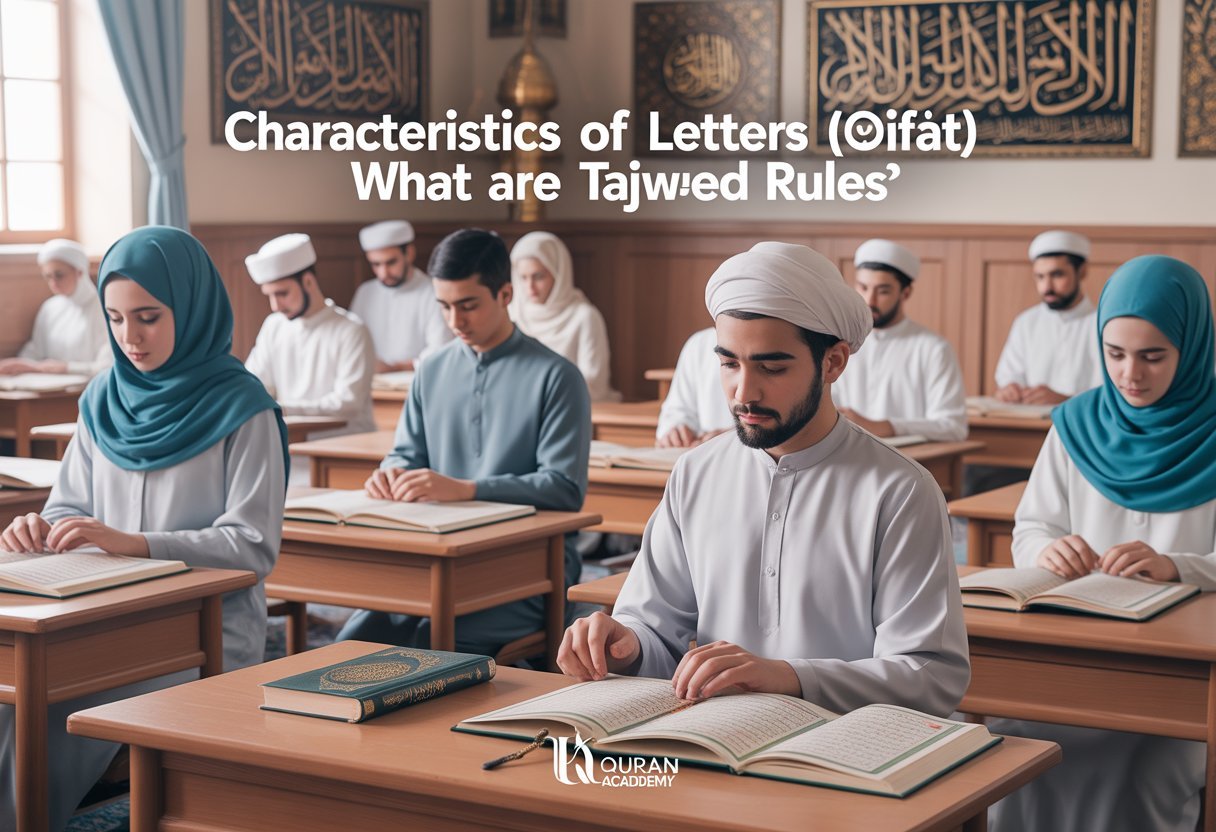
Ṣifāt are the qualities that make each Arabic letter unique. They help you tell apart letters that come from the same place in the mouth or throat.
What are Ṣifāt?
Ṣifāt are the traits that shape how a letter sounds and feels when you say it right. Without them, letters from the same spot would sound exactly alike—which would be a nightmare for Quran recitation.
Types of Characteristics
Arabic letters have different qualities:
| Quality Type | Examples |
|---|---|
| Soft letters | ه، و، ي |
| Strong letters | ق، ط، ب |
| Breathed letters | ه، ح، خ |
| Non-breathed letters | ب، د، ج |
Essential vs Accidental Ṣifāt
Some characteristics never change—these are essential characteristics like strength, softness, and breathiness.
Others are accidental, changing depending on where the letter sits in a word. These only show up in certain contexts.
Key Letter Groups
The 28 Arabic letters are sorted by shared qualities:
- Heavy letters (Isti'laa): ص، ض، ط، ظ
- Light letters (Istifaal): All others
- Whispered letters (Hams): ف، ح، ث، ه، ش، خ، ص، س، ك، ت
Understanding ṣifāt is the backbone of good Tajweed. It’s the difference between average and truly beautiful recitation—and it all starts with knowing your letters inside out.
Fundamental Tajweed Rules

These four core tajweed rules are the backbone of proper Quranic recitation—especially when noon saakin or tanween meets certain letters. Each rule dictates how sounds should be pronounced, merged, converted, or concealed, keeping the recitation authentic and faithful to tradition.
Izhar (Clear Pronunciation)
Izhar literally means "to make clear." It applies when noon saakin or tanween is followed by one of the throat letters.
The reciter has to pronounce the noon sound distinctly, with no blending or nasalisation sneaking in.
The six throat letters for izhar are:
- ء (Hamza)
- هـ (Haa)
- ع (Ain)
- ح (Haa)
- غ (Ghain)
- خ (Khaa)
When any of these follow noon saakin or tanween, the noon must stand out. Otherwise, you risk muddling up words and the intended meaning.
Take "من آمن" (man aamana) for example—the noon is pronounced clearly before the hamza. Don’t rush it; give that sound its due.
At UK Quran Academy, we see students often wanting to blend the sounds, probably out of habit. But clarity is non-negotiable here.
Idgham (Merging Sounds)
Idgham means "to merge." It kicks in when noon saakin or tanween bumps into specific letters, causing the sounds to blend smoothly.
This rule splits into two types, each affecting the recitation in its own way.
Idgham with Ghunnah (Nasalisation) involves four letters:
- ي (Yaa)
- ن (Noon)
- م (Meem)
- و (Waaw)
Here, the noon merges with the next letter but keeps a nasal tone for two beats. In "من يقول" (man yaqool), the noon blends with yaa but you still hear the nasalisation.
Idgham without Ghunnah applies to two letters:
- ل (Laam)
- ر (Raa)
In this case, the noon vanishes into the next letter—no nasal sound at all. For "من لدن" (min ladun), the noon just melts into the laam.
Iqlab (Conversion)
Iqlab, or "conversion," is specific: it happens when noon saakin or tanween is followed by ب (Baa). The noon sound flips into a meem, with a light nasalisation.
Why? Pronouncing noon before baa is awkward for your mouth. Changing to meem makes it flow easier.
In "أنبتنا" (anbatna), the noon before baa turns into a meem—with a gentle nasal sound. Your lips should close as if you’re saying meem, not noon.
The nasalisation lasts for two beats, similar to idgham with ghunnah. But here, you’re actually swapping out the sound entirely.
Many students at first find iqlab a bit fiddly. It takes some time and practice for it to feel natural.
Ikhfaa (Concealment)
Ikhfaa means "to conceal." It applies when noon saakin or tanween meets any of the other fifteen letters not covered by the previous rules.
You don’t pronounce the noon clearly, nor do you merge it completely. It’s a hidden, soft nasal sound.
The fifteen ikhfaa letters are: ت، ث، ج، د، ذ، ز، س، ش، ص، ض، ط، ظ، ف، ق، ك
During ikhfaa, you hold a gentle nasal sound for two beats. The noon is kind of in-between—neither here nor there.
For example, in "منطق" (mantiq), the noon before taa is concealed with a light ghunnah. Your tongue heads toward the next letter’s position, but keeps the nasal feel.
This rule is probably the trickiest. It’s not as clear-cut as izhar or as obvious as idgham or iqlab, so it takes some getting used to.
Additional Essential Tajweed Rules

Beyond the basics of noon sakinah and tanween, there are other tajweed rules you’ll need for proper Quranic recitation. These cover things like meem sakinah, the echoing qalqalah letters, vowel elongation, and nasalisation in certain cases.
Rules of Meem Sakinah
Meem sakinah is the letter meem (م) without a vowel. How you pronounce it depends on what letter comes next.
Ikhfa Shafawi (Labial Concealment) shows up when meem sakinah meets ba (ب). The meem gets hidden, but you keep a nasal sound—ghunnah. Like in "يعتصم بالله" (ya'tasim billah), where the meem blends softly into the ba.
Idgham Shafawi (Labial Merging) happens when meem sakinah is followed by another meem. The two meems merge, giving you a strong, nasalised meem for two counts.
Izhar Shafawi (Labial Clarity) is for when meem sakinah comes before any letter except ba or meem. Here, you pronounce the meem clearly, with no blending. At UK Quran Academy, we drill these subtle differences so students can feel them instinctively.
Qalqalah (Echoing Sound)
Qalqalah is that echoing bounce you hear when certain letters are stopped. The five qalqalah letters are: qaf (ق), ta (ط), ba (ب), jeem (ج), and dal (د).
When these letters have sukun or end a word where you pause, you get a slight bounce. It’s just how your mouth closes off the sound.
Minor qalqalah is in the middle of a word with sukun. Major qalqalah is at the end of a verse or when you stop completely.
For instance, in "أحد" (ahad), the dal at the end bounces. Or in "الفلق" (al-falaq), the qaf echoes. At UK Quran Academy, we pay special attention to qalqalah—it really makes a difference in recitation quality.
Madd (Vowel Elongation)
Madd is all about stretching certain vowel sounds. The main madd letters are alif (after fatha), waw (after damma), and ya (after kasra).
Natural madd (madd tabi'i) is two counts—simple enough. Connected madd (madd muttasil) is when a madd letter meets hamza in the same word, so you stretch it 4–5 counts.
Separated madd (madd munfasil) is when a madd letter at the end of one word meets hamza at the start of the next; again, 4–5 counts. Necessary madd (madd lazim) is a full six counts—no shortcuts.
| Madd Type | Duration | Example |
|---|---|---|
| Natural | 2 counts | قَالَ |
| Connected | 4-5 counts | جَاءَ |
| Separated | 4-5 counts | فِي أَنفُسِهِمْ |
Noon and Meem Mushaddadah
When noon or meem has a shaddah (ّ), it needs extra care. The shaddah means the letter is doubled and strengthened.
Noon mushaddadah gets a clear nasal sound for two full counts. Like in "إِنَّ" (inna), where the noon is unmistakable and nasalised.
Meem mushaddadah is similar, but you feel it through the lips. "أُمَّة" (ummah) is a classic example.
For both, you want the nasal sound to last the full duration. At UK Quran Academy, we run through plenty of drills to help students master these subtle details—because they matter for a truly authentic recitation.
Practical Approaches to Learning Tajweed

Learning tajweed isn’t something you just pick up from a book. You need proper guidance, good resources, and—let’s be honest—regular practice if you want to get the pronunciation and articulation right.
In the UK, you’ve got options: traditional face-to-face classes, or online platforms that let you learn from home. Both can work, depending on your schedule and preferences.
Studying with a Qualified Teacher
Honestly, nothing beats learning from a qualified tajweed instructor. They can catch mistakes on the spot and give feedback tailored to you—something you just won’t get from a video or textbook.
UK Quran Academy has instructors who really understand the challenges British learners face. They use proven methods to help students get to grips with makhaarij (how to pronounce each letter) and sifaat (the qualities of each sound).
Here’s what a good teacher brings to the table:
- Instant corrections when you slip up
- Lessons that fit your pace and needs
- Understanding of UK context and accents
- A clear curriculum that covers all the essentials
One-to-one sessions mean you get personal attention. Teachers can show you exactly how to position your mouth and control your breath—key stuff for accurate recitation.
Plenty of UK learners now go for online classes, mainly for the flexibility. You still get top-quality teaching, just without the commute or dress code.
Resources for Self-Learning
Self-study materials can really boost what you learn in class. They let students practise in between lessons at their own pace.
Digital resources have completely changed how people pick up tajweed rules outside the classroom. There's just so much more out there now than there used to be.
Essential learning materials include:
| Resource Type | Benefits | Examples |
|---|---|---|
| Audio recordings | Proper pronunciation models | Quranic recitations by expert qaris |
| Mobile apps | Interactive practice exercises | Tajweed learning applications |
| Written guides | Reference materials | Rule books with Arabic examples |
| Video tutorials | Visual demonstrations | YouTube channels by certified teachers |
Modern technology makes learning more engaging. Some apps even use voice recognition, giving instant feedback on pronunciation—pretty handy if you're not sure how you're sounding!
UK Quran Academy doesn't just stick to live classes. They also offer a solid range of digital resources, like recorded lessons and practice exercises, all available through their learning platform.
Books still matter, too. They're great for looking up rules or checking examples from the Quran when you want to study on your own.
Tips for Consistent Practice
Regular practice is key for building muscle memory and getting comfortable with fluent recitation. Honestly, students who make time for daily practice usually see much faster progress than those who only study now and then.
Effective practice strategies include:
- Daily sessions—aim for at least 15-30 minutes each day
- Recording practice so you can spot your own mistakes
- Slow recitation—take your time, focus on accuracy more than speed
- Repetition—go over tricky verses until they feel natural
It's worth setting up a proper practice schedule, even if it feels a bit formal. Many people at UK Quran Academy find that morning sessions work best, since the mind tends to be clearer and it's easier to focus before the day gets busy.
Listening to skilled reciters can really help with rhythm and flow. Try imitating the style of well-known qaris, but don't forget to stick to the tajweed rules you've learned along the way.
Group practice can be surprisingly motivating. Reciting together lets students learn from each other’s strengths, and sometimes you pick up on things you wouldn’t notice alone.
Start Your 1-on-1 Quran Journey with Certified Male & Female Tutors
Join 500+ satisfied students across the UK, USA, and Europe. Learn Noorani Qaida, Tajweed, or Hifz with customized flexible schedules and interactive LMS tracking.
About The Author: Super Admin
UK Quran Academy Editorial Team is dedicated to sharing authentic Islamic knowledge, Quran studies resources, Tajweed guides, and educational insights to help students on their spiritual and academic journey.